

18 February 2026 - Timothy Gibbs
Getting beyond the formal/informal divide
South African pastoralists and the popular economy
Are the distinctions between ‘formal’ and ‘informal’ meat production in South Africa helpful?
Since the 1980s, South African cattle commodity chains have concentrated around a handful of industrial-scale feedlots. Today, these industries fatten and slaughter around 65-70% of the beef consumed inside the country. In turn, much of the policy literature asks how might emerging African pastoralists and cattle farmers (described as ‘informal’ and ‘emerging’) break into these value chains and adopt industrial (described as ‘formal’) methods of production.
Yet our obsessions with industrial size and scale – seen in popular TV shows such as Megaboere (mega-farmers), now into a fifth series on ShowMax – means that we sometimes too crudely differentiate between formal cattle farming and informal pastoralism.
The point of this blog post is to suggest a counterintuitive set of arguments. Firstly, the myth of the megaboere is oversold. Only a very brave (or foolish) new entrant would make new investments into this very risky sector of the economy. Second, away from the industrial farming/abattoir nexus, a wide range of pastoralists are doing very well in the burgeoning small/medium-scale networks of cattle speculation, slaughter and butchery. Thirdly, as much as the Big Five supermarket chains have bludgeoned their way into township markets, many South African consumers still buy a significant amount of their meat from neighbours and small butchers.
In short, for all that policymakers often claim that there is a stark line between the industrial/commercial (i.e. White Monopoly Capital) and informal (i.e. African) segments of the meat industry, a closer investigation of the tangled value chains suggests the interconnectedness of the agrifood system.
With the current outbreak of foot-and-mouth disease (FMD), many South African farmers across scales are suffering. The government’s problematic response to FMD shows why these tangles and interconnections matter, and highlights the informal and formal ways that livestock farmers deal with disease, markets, laws and regulations.

The myth of the Megaboere
In one sense, the core of the South African agrifood system is indeed consolidated around a concentrated set of commercial interests.
Take the example of the Karan family that runs the largest cattle feedlot in South Africa and (arguably) the Southern hemisphere. Their 2,330-hectare site, just south of Johannesburg, intensively fattens and slaughters up to 210,000 young weaners at a time. They have recently acquired another feedlot in KwaZulu-Natal. They have been the focus of an R5.2 billion Black Economic Empowerment share deal. Their increasingly concentrated interests haven’t gone unnoticed: the Competition Commission is paying attention.
At the same time, feedlotting is a risky business that yields only wafer-thin profit margins. South Africa’s highly capitalised, high-volume feedlots operate along lengthy commodity chains, and they are price-takers (not price-makers) in ultra-competitive globalised markets.
Take the example of the high-protein soya feed that feedlotters require to bulk up their cattle, which is typically imported from Brazil. When global soya prices spiked in 2012, and again in 2021, South African feedlotters faced steeply rising costs and feared going into a death spiral. The sudden collapse of South Africa’s once-thriving broiler chicken industry — brought down by a surge of cheap Brazilian imports – underscores a hard truth: in the post-apartheid era, government protection offers little defence against the volatility of global markets.
Pastoralism in a burgeoning popular economy
The second factor that deserves more attention is the question of how the post-1994 deregulation of the meat industry allowed the expansion of the livestock trade outside the industrial feedlot/abattoir nexus.
Figures are sketchy, given that livestock controls and monitoring crumbled after 1994. Nonetheless, a swathe of research agrees there has been the growth of a diverse group of relatively small-scale livestock owners, speculators and butchers who sell grass-fattened cattle into local markets, typically generating higher profit margins (per unit/animal) by mobilising their local knowledge and connections. The term ‘informal’ fails to capture the complexity and scale of this R7.8 billion market.
Thus far, most studies have focused on the continued importance of African pastoralism on communal land. Indeed, it is estimated that 30-40% of the South African national herd is found here. This figure points towards the resilience of rural livelihoods in contemporary South Africa despite the brutal dispossession characteristic of apartheid.
Heuristically, a range of research has described a wide diversity of owners. At one end of the scale is the proverbial widow who owns one cow and some chickens, and sells during times of need: with cattle going for R10,000 per head, one sale is roughly the equivalent to a year of child grants. At the other end, one finds the schoolteacher, local official, and successful minibus-taxi owner, holding 20-50 cattle, and selling more often and with profit in mind, typically to a neighbour who needs to slaughter for a ceremony.
Growing networks, changing patterns
Perhaps the more interesting challenge for researchers will be to map the tangled web of networks that are bringing large (if unknown) numbers of grass-fed cattle to city markets. Historically, these networks first became visible in the final years of apartheid, as pass controls and meat hygiene regulations fell away, and a variety of roadside markets, slaughter-pens and butchers appeared on the edges of cities.
Initially, it seems that much of this trade was dominated by white farmers and Indian middlemen who, in a segregated society such as South Africa, were more likely to hold the necessary capital and business licenses to establish livestock depots on the peri-urban outskirts of the city. Today, a generation after the end of apartheid, industry insiders speak of the expansion of African family-based businesses. Successful minibus-taxi owners, for instance, are known for investing their profits from this notoriously cash-in-hand business into a variety of related ventures across a connected set of value chains: typically, butcheries (shisanyama), bottle stores and small beef herds.
Importantly, many African cattle traders are buying and leasing smallholdings because access to pasture and fodder during the dry winter months is the critical factor between making a profit and incurring a loss. There are also a small number of wealthy politicians and well-connected business families who have leveraged Black Economic Empowerment schemes to acquire land reform farms and small rural abattoirs at bargain prices. Indeed, Durban’s wealthiest minibus-taxi family is said to have recently purchased a couple of cattle farms that will supply their taxi-rank butcheries with a consistent supply of slaughtered meat.
Thirty years after the end of apartheid, patterns of landholding have been somewhat disrupted. We can no longer simply contrast commercial (white-owned) cattle farms with pastoralism on communal (African) land.
Supplying to both (formal) supermarkets + (informal) shisanyama butcheries
My final point is that whilst supermarkets hold enormous influence within the agrifood system, they remain only one part of a much broader and more complex food economy.
The growth in pensions and social grants means that popular consumption (i.e. the food expenditures of deciles 1-5) accounts for the fastest growing portion of consumer food markets since 1994. Whilst the Big Five supermarket chains have launched ambitious campaigns to capture this portion of the consumer market, building their superstores in townships and small towns across the country, the South African popular classes still buy a significant amount of meat from a range of licensed or unlicensed small butcheries and open-air shisanyamas. (It is only rich people who buy all their meat in the supermarkets.)
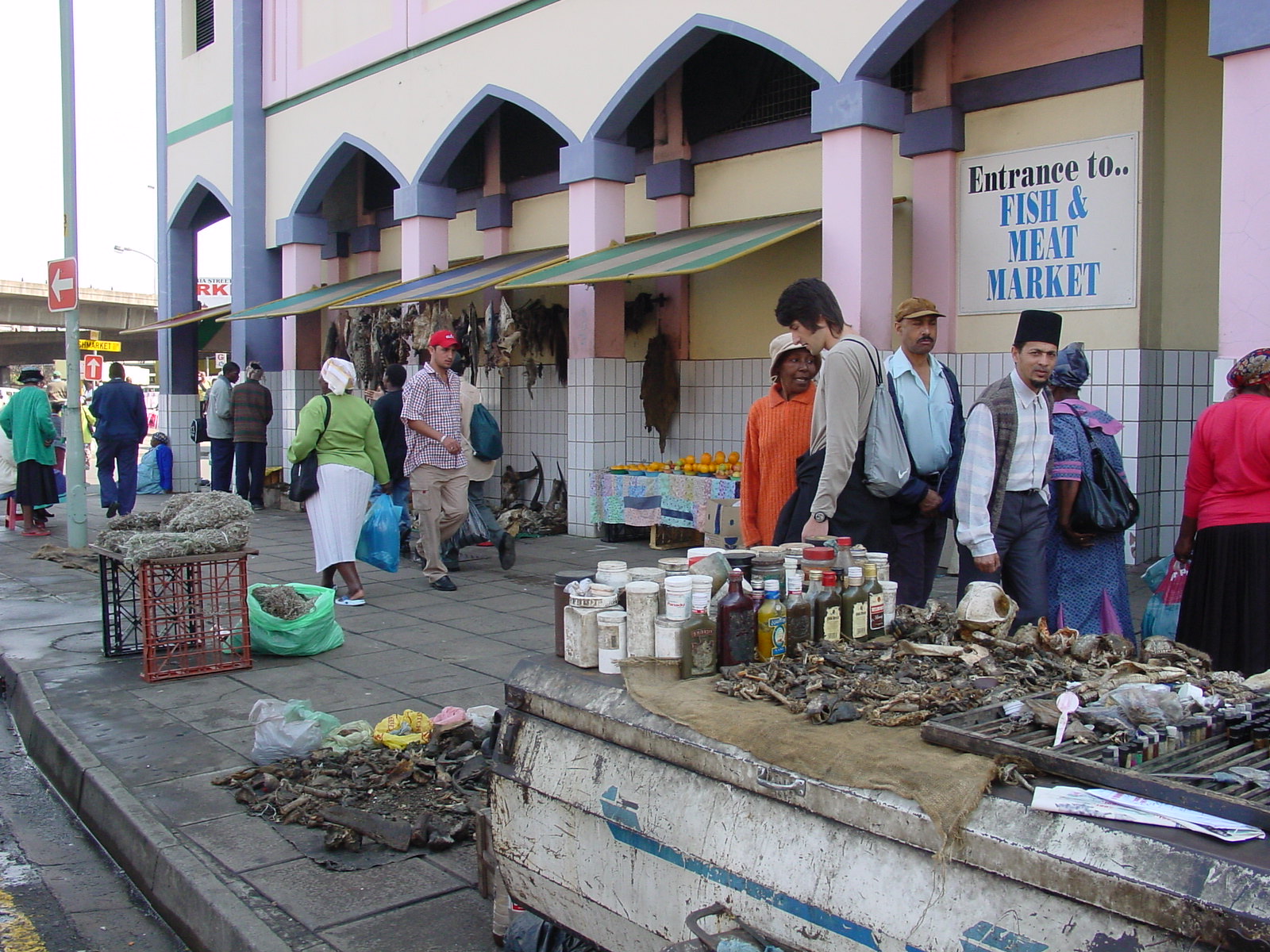
The complexity of South African meat-buying habits becomes obvious when standing in the bustling complex of shops and open-air markets that surround Durban’s downtown transport exchange. If you pause for a moment during rush hour and simply look around, the sheer diversity of meat on offer tells a fascinating story.
On one end of the spectrum there are the big-brand supermarkets with shelves loaded full of industrially manufactured, low-priced boerwors and polony. Just a few steps away you’ll find thriving family-owned mini-supermarket butcheries that specialise in slaughtering either lamb or beef, sourced directly from a few local smallholdings just outside the city. Then there is the offal and cow heads cooked on the open fires by market-women at the taxi-ranks, which is sold as snack foods to passing commuters. This produce is most often sourced from the largest industrial slaughterhouses in the province. (It arrives at dawn in frozen 10kg packs that will have thawed out by the end of the day.) And on the fringes of this ecosystem, a few butchers illegally bring live animals into the city centre, slaughtering them right on the roadside and disposing of the waste in the stormwater drains. Thus, open-air butcheries, family-run stores, and supermarket chains rub along next to each other every day of the week.
For all that there is a difference between intensively fed, grain-fattened cattle that pass through the industrial feedlot/abattoir nexus and the grass-fed cattle being sold into local markets, South African policymakers still tend to draw an overly crude line between ‘formal’ commercial farming and the so-called ‘informal’ pastoralism on communal land.
Yet the most dynamic spaces in the country’s beef economy lie elsewhere. They are in the growing small- and medium-scale networks of cattle trading, slaughter, and township butchery. This is where the real energy of the sector sits today, and where its future is unfolding.
Coda: Will FMD change the formal/informal divide?
Shortly after I wrote this blog, many of the cattle auctions and formal markets in KwaZulu Natal were shut down because of a new outbreak of foot-and-mouth disease (FMD).
All South African farmers are suffering – not least because the slow, inept government response reduces certainty for everyone.
With events moving so quickly, it is impossible to assess how FMD will transform pastoralism and to imagine what the South African livestock sector will look like once the crisis has passed. But a few trends have been widely discussed in the farming media.
First and foremost, the stringent but ham-fisted approach to rules and regulations taken by the government (combined with the weak implementation and regulatory capacity of the state) will likely hurt small farmers and pastoralists most of all. In recent months, it has proven almost impossible for small farmers to obtain the vaccines and the ‘clean bill of health’ certificates that will allow them to legally transport, sell and slaughter their animals.
With legal channels blocked, there are numerous stories that South African farmers are ‘making a plan’ and moving animals illicitly along back roads towards the major city markets. This, in turn, undermines traceability and increases the risk of contact between herds meaning that FMD will last for longer.
There are parallels here. An inept government attempt to ban smoking during the COVID crisis led to a major increase in tobacco smuggling. Do not be surprised if the South African meat industry sees a similar thickening of informal and illicit (and sometimes outright criminal) networks of trade.
Featured image: Market in Durban, 2002 – DSC05566 by Alan A. Lew (Creative Commons by-nc-sa 2.0)
Read more
The REPAiR Project blog brings diverse views from our project team and collaborators into conversation around key themes and ideas.
Related posts
27 December 2025 - Amber Huff & Linda Pappagallo
Rethinking what we think we know about rangelands and pastoralism
In this introductory blog on ‘rangeland myths’ we emphasise the need to rethink what we think we know about rangelands and pastoralism in ways that are open to diverse perspectives, experience and knowledges.
12 November 2024 - Farai Mtero
Creating equitable pathways in South African rangelands: why history and politics matter
To understand the challenges of landscape stewardship in South Africa, we need to appreciate how rangelands have been shaped by history, and how this continues to affect the way rangelands are governed today.