
29 September 2026
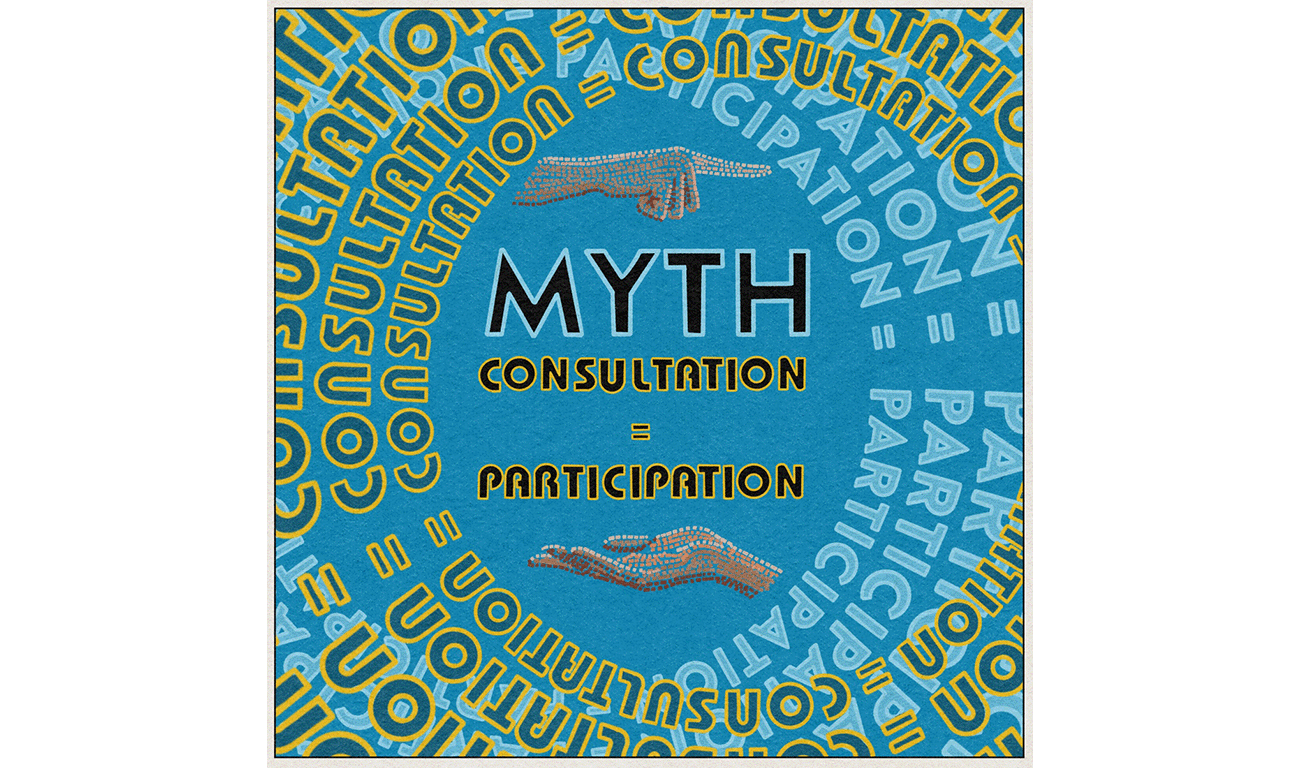
Myth: ‘Consultation = Participation’
by Linda Pappagallo, Olivia Crowe and Amber Huff
Participation is a long-established ‘buzzword’ in sustainable development. Labelling a programme or project participatory is a common way to signal that a funder or implementer has virtuous aims – for example, of inclusion, equity, to improve local ownership of a project and ensure long-term positive impacts for beneficiaries.
However, it is important to compare programme framings to dynamics ‘on the ground’. Projects often promise an empowering and ‘bottom-up’ process of participation – but, in practice, they are delivering conventional consultation, in which objectives and power for decision making ultimately remain with experts, external actors and relatively elite local stakeholders.
The myth that consultation = participation
By treating the two concepts as interchangeable in practice, the myth that ‘consultation = participation’ perpetuates a cloud of fuzziness and confusion, and can exacerbate risks and hazards for progressive projects and their intended beneficiaries alike.
It can create the appearance of inclusion without necessarily changing who makes decisions. It can amplify claims of equity without effecting whose knowledge really counts in designing an initiative. It can gesture toward transformation without acknowledging or impacting the structural constraints that shape how projects unfold. Creating opportunities for people to express their views, manage external projects or give permission to them is not the same thing as giving people substantial power to shape what happens to them.

The radical roots of participation
This persistent conflation is particularly important because the contemporary concept of participation was not conceived as a neutral project-management tool. Participation has radical roots. It arose from emancipatory education movements and aligned scholarship that advocates a praxis combining work to dismantle hierarchies of knowledge and expertise, facilitate critical reflection and enhance capacity for collective action.
This radical form of participation aimed not just to include working and marginalised people by holding a workshop, achieving informed consent, or opening a seat at the meeting table to a local leader. Participation aimed to fundamentally transform the social structures that marginalise, disempower and result in oppression of everyday people in the first place.
Depoliticization and contestation
From the early 1980s, discourses of participation became ubiquitous in the field of international development and the meanings attached to the concept by different groups multiplied. Its precise meaning became more and more difficult to discern.
Participation was even embraced by powerful multilateral organisations like the World Bank and IMF and continues to be widely used to signal a ‘people friendly’ approach to development, in response to critiques of exclusionary or ‘top-down’ programme design and execution.
As its use became more and more prevalent, involving a plurality of actors and meanings, participation in this sense lost its emancipatory political edge. It became widely understood as part of the ‘methods’ and ‘management’ toolbox. In the process, what Cooke and Kothari famously described as the “tyranny of participation” became institutionalised, routinely attached to projects that were temporary, budget-bound, designed from above and externally managed.
As a technical ‘checklist’ item, delivered through workshops, focus groups, and facilitation exercises, the normative notion of participation had become very distant from its original intent.
But, at the same time, more radical traditions have also multiplied and persisted. Some of these, like forms of participatory Action Research (PAR), found amplification in activist and critical development spaces. They have been used to push back against the depoliticizing and instrumentalising tendencies (and harmful material effects and unjust outcomes) of neoliberal development approaches.
The malleability of ‘participation’
This history underlies the fact that participation is a contested and fuzzy idea.
Of course, different people and fields may simply have very different things in mind when they use the word. But that’s not what we are critiquing here. The problem isn’t just that one word can mean different things. It is rather that with participation, as with many terms, meanings are malleable. Its meaning can change depending on the setting and who is speaking it or making claims to it, while the authority and symbolic power to signal virtuous intent and label virtuous practice that the word often carries are retained.
Conceptual fuzziness and malleability means that ‘participation’ can be, for example, used with sincere intent by project designers, but in processes of implementation, can shift to being deployed in ways that close down (rather than open up and shift) political horizons for people who have long experienced marginalisation, neglect and violence. Of course, these tendencies can be recognised and actively subverted as well.
‘Seeing’ the myth in practice
Such turns in framing are particularly likely when conflicts or complexities arise among project beneficiaries in ways that confound simplistic assumptions, for example, about how ‘communities’ or ‘local people’ operate.
Being able to recognise the fuzziness and malleability of terms through time and across contexts is itself empowering. In doing so we can begin to see more clearly how the boundary between consultation and participation can be far less obvious in practice than participatory development manuals may lead us to beleive.
Participatory processes are, first and foremost, design choices about who gets to influence decisions, when, and with what consequences. They are fundamentally about deciding the rules of the game.
For example, how can a livestock farmer in the Pyrenees participate in the design of a new milking machine? Who counts as an expert, and who is excluded?
The farmer may well be consulted – she may be asked if she would like a new machine and be offered training on how to use it. She may be invited to attend workshops, sign attendance sheets, or comment on management plans. Participation, however, would imply involvement in designing the machine itself and arrangements governing access to it.
The distinction is fundamental. While consultation may simply involve asking for permission or an opinion, participation implies agency: the possibility of influencing decisions, shaping processes, or having a say in outcomes, even when that means refusal.
By and large, consultation functions more as a mechanism for demonstrating procedural legitimacy than as a means of establishing shared governance.
Key assumptions in participatory development processes
The limits of participation-as-discourse
Statements such as “inclusive participation in rangeland restoration strengthens local legitimacy, yields better outcomes, and ensures that restoration solutions are better aligned with community needs” point to efficiency gains, stronger buy-in, and better outcomes associated with participation. This instrumentalized use of the concept diverges from participatory processes imagined by the traditions of emancipatory pedagogies, where the end-goal is not efficiency and procedural guarantee, but a revelatory process itself that allows to ask and address the critical questions introduced above. The complexity of participation lies in being able to answer these fundamentally political questions and enable people to subsequently act based on the answers they find.
‘More is better’
Alongside instrumentalization, another danger is that we may romanticise participation. The assumption that some participation, even if done badly, is better than none can remain unquestioned in project development, drawing from the implicit belief that ‘more is better’. Rather than pointing at quality, ‘bad’ participatory approaches often carry unwarranted assumptions – that living together naturally generates trust, cooperation, and social capital. They assume that local knowledge is inherently valuable, and that communities are endlessly resourceful.
Yet we know that conflict, inequality, gerontocracy, patriarchy and patronage deeply shape everyday social life and thus are also present in simple meetings or facilitated in ostensibly participatory activities. Living together or discussing together does not automatically produce harmony – even when well facilitated.
Processes convened without due attention to such dynamics can inadvertently reinforce and exacerbate unhealthy power dynamics. The complex patronage that links aid money or financial incentives to layers of officials, contractors, politicians and local organisations creates a playing field so unequal that it absorbs much, if not all, of the contestation that might otherwise arise in community meetings.
Bad participatory processes do a lot more harm than good.
This is especially true for participatory processes that arrive ‘packaged’ from outside, or which carry assumptions that originate outside the communities and institutions that these processes seek to engage with. Induced participation, as opposed to organic participation, may disproportionately external ideals and visions of what ‘good governance’ is, what equity and justice mean, and what successful participation ought to look like.
Although participation has become formalised in the Anglophone development lexicon, we must be aware that there are many existing ways societies organise collective decision-making – which may not be ideal in ‘our’ eyes. Evaluations of participatory processes among Maasai pastoralists in land governance, for example, suggest that active participation in meetings, holding leadership positions, and influencing land-related decisions are very much dominated by elder generations. Even when women and young people are present, how do external interventions manage local cultural norms and values? Should implementers or researchers ‘interfere’ with power relations?
The myth of ‘the community’
Historically, ‘the community’ occupies a mythical position in development discourse, imagined as a naturally existing, internally coherent, homogeneous entity characterised with shared interests, mutual trust, and collective purpose. In their 1999 study of community-based natural resource management, Agrawal and Gibson argue that initiatives rarely deconstruct their idea of ‘community’ before designing around it. The assumption is embedded so deeply that it’s in the name of the approach: ‘community-based’.
These assumptions have led to interventions with processes that look inclusive on paper but end up driven by whoever already holds power within a group, or by an opportunistic sub-group seeking influence it didn’t have before. Ignoring local power dynamics can entrench existing inequalities, magnify conflict, or simply cause interventions to fall apart because their introduced practices depend on an ideal of social relations that doesn’t correspond to reality.
The same premise extends to development projects more broadly. Development projects frequently assume that one identifiable community exists within any given location, and that ecological, administrative, and social boundaries coincide. Yet people belong simultaneously to multiple communities, networks, and institutions. Seasonal mobility, kinship, labour migration, ethnicity, gender, religion, and livelihoods all create overlapping forms of power and belonging that rarely align neatly with project boundaries.
The very act of defining a community inevitably decides who falls inside its rights, decision-making, and benefits – and who is excluded. This brings us again to a fundamental question in participatory work: who is absent?
Design fixes to overcome the ‘consultation = participation’ tendency
Research overwhelmingly shows that age, gender, class, and livelihood shape people’s ability to participate. The question therefore becomes not simply who participates, but who is absent – and why.
A 2024 study of a community-based conservation programme in West Kalimantan, Indonesia, illustrates this problem. The programme was designed with particular attention to removing barriers: they did over 250 hours of focus group discussions across 9 villages, which fed into chosen activities and elected governance bodies to set priorities and oversee implementation. Yet engagement ranged from 85% down to 15%. When researchers asked people why they didn’t engage, they explained that they were too busy (often with childcare), that they didn’t really understand the programme, and that they simply weren’t invited. The situation was read differently by some of the staff informants, who attributed busyness to poor time management or laziness.
The example highlights a disconnect between what extension support might perceive and the perceptions of the people being engaged; it also shows that time availability and perhaps local power dynamics were still shaping what and how information flowed.
The same logic applies to pastoralists. Daily livestock management, seasonal migration, labour demands, and household responsibilities can make attendance at workshops or consultation meetings difficult, regardless of willingness.
The design question that follows is: if a particular group is absent, such as young women with small children, how do we design processes that ensure decision-making about the design of an intervention includes them?
Designing for inclusion through participation and not consultation
Taking the example of childcare, a response might involve discussion with childcaring women to decide whether and how they might want to engage – such as through women’s groups, family members, or home visits.
Providing access to a decision-space is the first part of the challenge. Coming back to the question of the Pyrenean farmer and the milking machine: the intention isn’t to get her opinion on how the machine should be used, but for her to have a hand in designing the blueprint. The questions that follow might include: How can her priorities shape the agenda? Is there a way to check whether her perspective changed anything? Can she dispute an outcome or hold leaders to account? A process that solves childcare logistics perfectly can still produce a better-attended version of the same plan.
Designing for inclusion in this way is political. Importantly, pushing for inclusion can disturb a local order in ways that expose the newly ‘included’ person to harm, gender-based violence being a stark example. Research on women’s economic empowerment found that deviating from local norms carries an increased risk of partner violence, impacting poorer women more than their peers. Recognising this pattern doesn’t mean abandoning the goal of inclusion, but it does mean accepting that social change can cause conflict, and that an understanding of existing norms, appropriate safeguarding, and long-term commitment are needed. Working through existing bridges, such as established networks already engaged with the issue, perhaps locally or at a different scale, may be a useful first step.
Both practical and political constraints highlight the absurdity of imposing an external template for participation, whether that’s a meeting format, gender quota or governing body structure, without understanding the logic already governing who is and isn’t there. What counts as a fair process is also plural (within and among ‘communities’) and scenario-dependent, so there is no ultimate design fix that travels easily from one place to another.
However, there are a few practical questions we can begin to incorporate in participatory processes:
Which decisions were fixed by the intervention before anyone affected saw them?
How is the intervention accountable to the people it affects?
Who controls information and data produced by the intervention, and is that different from who it’s about?
Is the intervention adapting to context over time?
When people don’t agree or interests compete, who gets prioritised, and how is this decided?
Is the intervention identifying new people to engage, or returning to those easiest to reach?
 Want to discuss myths about participation? Join our eighth rangeland myths online conversation of 2026, on the myth that ‘consultation equals participation’, on Friday 23 October.
Our speakers are Fozia Noor (IYRP Gender & Pastoralism Working Group / Somali Women Pastoralists Network), Kholosa Magudu (Meat Naturally Africa) and Nosiseko Mtati (Meat Naturally Africa). Local Field Officers from Meat Naturally Africa will also contribute to the discussion. The discussion will be co-chaired by Linda Pappagallo, Adrian Nel and Olivia Crowe.
We warmly invite anyone with an interest in rangelands, pastoralism and myths about them, to join, share your stories and rethink how we ‘see’ rangelands and pastoralism.
Related posts

27 December 2025 Amber Huff & Linda Pappagallo
Rethinking what we think we know about rangelands and pastoralism
In this introductory blog on ‘rangeland myths’ we emphasise the need to rethink what we think we know about rangelands and pastoralism in ways that are open to diverse perspectives, experience and knowledges.
5 December 2025 Amber Huff & Linda Pappagallo
Exploring rangeland myths in 2026
Through 2026, the REPAiR is hosting a series of activities that explore ‘rangeland myths’ in global perspective. We offer an open invitation to get involved, share your experiences and stories, and help us to rethink what we think we know about rangelands and pastoralism.