


2 March 2026 - Linda Pappagallo
Myth: Pastoralists need more markets to thrive
The myth that pastoralists simply need ‘more markets’ to thrive rests on a set of deeply rooted assumptions about markets and animal husbandry.

In March, the International Year of Rangelands and Pastoralists is exploring the theme of Livelihoods and Economics. In this think piece we reflect on the myth that “pastoralists need more markets to thrive”. Why does this idea still persist, often as if it is ‘common sense’?
As with other rangeland myths, the market myth is deeply embedded. It originates from developmentist and explicitly colonial clichés that emphasize the need for capital accumulation, growth and market integration.
In Southern Africa, beef markets expanded with the growth of colonial mining, driven by mine owners’ demand for cheap protein to feed their workforces. Apartheid administrators and development programmes have long focused on de-stocking communal rangelands through narratives of overgrazing and degradation.
As in other parts of the world, destocking arguments have then been coupled with arguments in favour of market integration. Development policies focus on inducing pastoralists and extensive livestock farmers to sell into ‘the market’, at times by implicitly implying that pastoralists are ‘irrational’ and ‘uneconomic’ and need to be aligned with more ‘rational’ market logics.
Meanwhile, modern development thinking has long been dominated by mechanistic, productionist views of animal husbandry. These lie behind imaginaries of managing livestock as metabolizing ‘vats’, managing farms as input-output production models, and milk and meat as commodity frontiers. These imaginaries continue to reproduce specific dominant ideals of livestock markets.

Beyond ‘common sense’
Commodities are not the only ways to think about livestock. Livestock are integral parts of social-ecological landscapes: grasslands need herbivores (including livestock) and fire, just as herbivores need grass and fire. Livestock are also part of a set of culturally shared cognitive frameworks, including rites, religious ceremonies, and food habits.
One way that cultures around livestock have been understood is through concepts like the ‘cattle complex’, later revised into the ‘bovine-mystique’. The ‘mystique’ highlights the symbolic, moral, and cosmological meaning of cattle, as a way of organizing social relations (using the word ‘mystique’ deviates from the idea of a ‘complex’, a pathology or cognitive flaw). Although they are not always meant negatively, both the ‘cattle complex’ and the ‘bovine mystique’ have also been used to reinforce a settler- and western-centric narrative used to explain the incomprehensible failure of development projects. If livestock marketing projects fail, it must be because pastoralists do not understand how markets work. This view is often implicit and it reinforces the myth that “pastoralists need more markets to thrive”.
Some anthropologists have long described how the “building of herds and the building of society merge in the same practical process that is social, economic, and ecological all at once.” It is no surprise that many development practitioners and private investors in rural areas are often left scratching their heads, wondering why pastoralists do not sell at ‘peak’ conditions or when market prices are high – even when their market access is improved.
These ways of thinking about markets have been remarkably influential. The idea that ‘pastoralists need more markets to thrive’ remains deeply rooted in a series of rhetorical strategies that function as a development common sense, replicated throughout much of the history of ‘pastoral development’ and the expanding frontiers of colonial ranching.
Although livestock-related policies in Asia, Europe, the Middle East and North Africa, South America and Southern Africa have diverse historical trajectories, agricultural development strategies around the globe have often converged on certain interventions like crossbreeding, ranching schemes, grazing reserves and feedlot operations. Never far from the surface, the underlying assumption is that pastoralism is backward, inefficient and in need of development. In a world where ‘bigger is better’, cattle used by mobile pastoralists are often seen as inferior. Most breeding schemes have attempted to increase the size of indigenous cattle through crossbreeding for a more European aesthetic.
Common-sense notions in development policy and national food security strategies tend to be at odds with the logics and timescales of extensive livestock production. Pastoralists operate on a seasonal basis; they may sell early to manage feed availability and cash needs; and they may work with higher stocking rates to reduce the risk of being forced to sell at low prices during drought. These complex and adaptive strategies are often misunderstood, resulting in a mismatch between livestock marketing policy and the realities of extensive farmers.
Narratives that ‘naturalise’ dominant production arrangements
For decades, policy making in animal husbandry has been dominated by two issues which have been framed as crises.
The first is overgrazing. From the 1930s, in the face of widespread drought and land degradation, colonial officials fixated on the question of how to control the supposed overgrazing by African pastoralists. They conveniently ignored that colonial land expropriation had created much of this crisis.
The second issue is food supply-demand bottlenecks. From the 1960s, policy making became fixated with hunger, food security, famines, droughts and population growth.
Deeply connected in the minds of government officials and institutional policy makers, these two issues found solutions in a condensed policy of livestock offtakes. The policy was designed to strategically manage the rate at which animals are removed from a herd through slaughter, sale, or transfer. Nowadays, offtake policies continue to evolve. From a focus on overstocking control to a risk management tool, they are still designed with ‘formal’ markets in mind.
The persistence of ‘formal’ views on markets is due to a series of modernization myths which include:
- the myth that formal markets can resolve multiple development challenges simultaneously
- the myth that pastoral livelihoods must be reorganised around formal market logics in order to thrive
- the myth that pastoral systems are modern if they conform toward market-dominated, sedentary, standardized production, where success is measured in terms of stocking rates, profit per hectare, litres of milk per cow, protein per kilogram of meat, and genetic improvement that favours fertility and yield. Although these dominant metrics may be of use in commercial ranching and intensive production models, they are less useful in non-linear, smaller-scale, family-owned, hybrid production systems.
What these myths have in common is that they ignore and conceal the specific logics and economics of pastoralism in different places and settings. Animal husbandry has never been an inward-looking or self-sufficient production system, isolated from surrounding economies and events. Trading or marketing animals is only one of many strategies, in settings where the herd-building process is not a purely profit-maximising venture, but one that relies on moral economies of reciprocity, redistribution, and herd accumulation.
Do more markets always lead to better livelihoods?
At the national level, offtake rates are often used as a proxy indicator for pastoral economic welfare. The underlying assumption is that market participation equals productivity, and that the higher the offtake rate, the greater contribution being made by pastoralists to GDP and the greater benefit accruing to their own wealth and welfare. These two benefits are often seen as directly related.
The supposed link between markets and wealth aligns with the technocratic notions of development and progress that have tended to dominate reporting and planning in national livestock sectors. These assumptions are not empirically neutral. They emerge from tools and indicators, so-called ‘trap doors’ that mis-measure the value of pastoralism and misrepresent pastoral production systems.
The question is not whether pastoralists need more markets, of course: but whose markets, on what terms, and for what benefit.
Challenging the myth
Challenging the ‘pastoralists need more markets to thrive’ myth does not mean rejecting markets altogether. Rather, it requires thinking beyond the market, and certainly beyond current dominant ideas of the ‘formal market’.
Challenging this myth, therefore, requires challenging ‘development common sense’ that assumes markets are most efficient when they are ‘formal’; that increased selling automatically improves welfare; and that market expansion is inherently beneficial. This means including how pastoralists perceive and respond to ‘markets’, rethinking how pastoralists engage in different kinds of markets, and how different animals have different production cycles and temporalities that cannot be forced into mainstream production strategies – like camel milk.
Challenging the myth also requires letting go of ‘either/or’ visions of markets, where markets are viewed either as informal or formal, and either commercial-oriented or subsistence-based. These visions lead to problematic national agricultural policies, like in Morocco, where agricultural policy is built on two pillars: one devoted to ‘high productivity and high added value’ agriculture, and the other pillar to ‘small-scale producers’. In turn, this further enshrines market dualisms that obscure the diverse and changing rationalities that shape pastoral engagement with markets, omitting a variety of in-between and hybrid cases that are climate resilient.
Finally, challenging the myth requires ‘deindustrializing the imagination’ and decolonizing animal science, including veterinary practices, ideas around welfare, markets and productivity. This means also challenging Western-influenced approaches centred on human beings and rethinking the Animal–industrial Complex that works to normalise animal commodification and maintain the dominance of intensive forms of animal agriculture. Opening up these perspectives can point to different ways of seeing economics, livelihoods and pastoral production.
 Want to discuss myths about markets? Join our third rangeland myths online conversation of 2026, on the myth of ‘pastoralists need more market access to thrive’, on Thursday, 26 February from 11:00 am – 12:30 pm GMT.
Our speakers are Timothy Gibbs and Oluwaṣeun Williams, and the discussion will be co-chaired by Ilse Köhler-Rollefson and Lars Otto Naess.
We warmly invite anyone with an interest in rangelands, pastoralism and myths about them, to join, share your stories and rethink how we ‘see’ rangelands and pastoralism.
Further reading
- Pastoralism and Livestock Marketing in Africa (briefing) by Andy Catley
- The Anti-Politics Machine: “Development” and Bureaucratic Power in Lesotho (article) by James Ferguson and Larry Lohmann
- Cattle’s Experiences of Colonialism – An Animal History of Southern Africa (book) by Michael J Glover
- Cattle Colonialism: An Environmental History of the Conquest of California and Hawai’i (book) by John Ryan Fischer
- Wanted Dead & Alive (book) by Gregory Mthembu-Salter
- Crossbreeding or not crossbreeding? That is not the question (blog post) by Saverio Krätli and Fred Provenza, PASTRES website
- Nourishment: What Animals Can Teach Us about Rediscovering Our Nutritional Wisdom (book) by Fred Provenza
- Hoofprints on the Land (book) by Ilse Köhler-Rollefson
Read more
The REPAiR Project blog brings diverse views from our project team and collaborators into conversation around key themes and ideas.
Related content
18 February 2026 - Timothy Gibbs
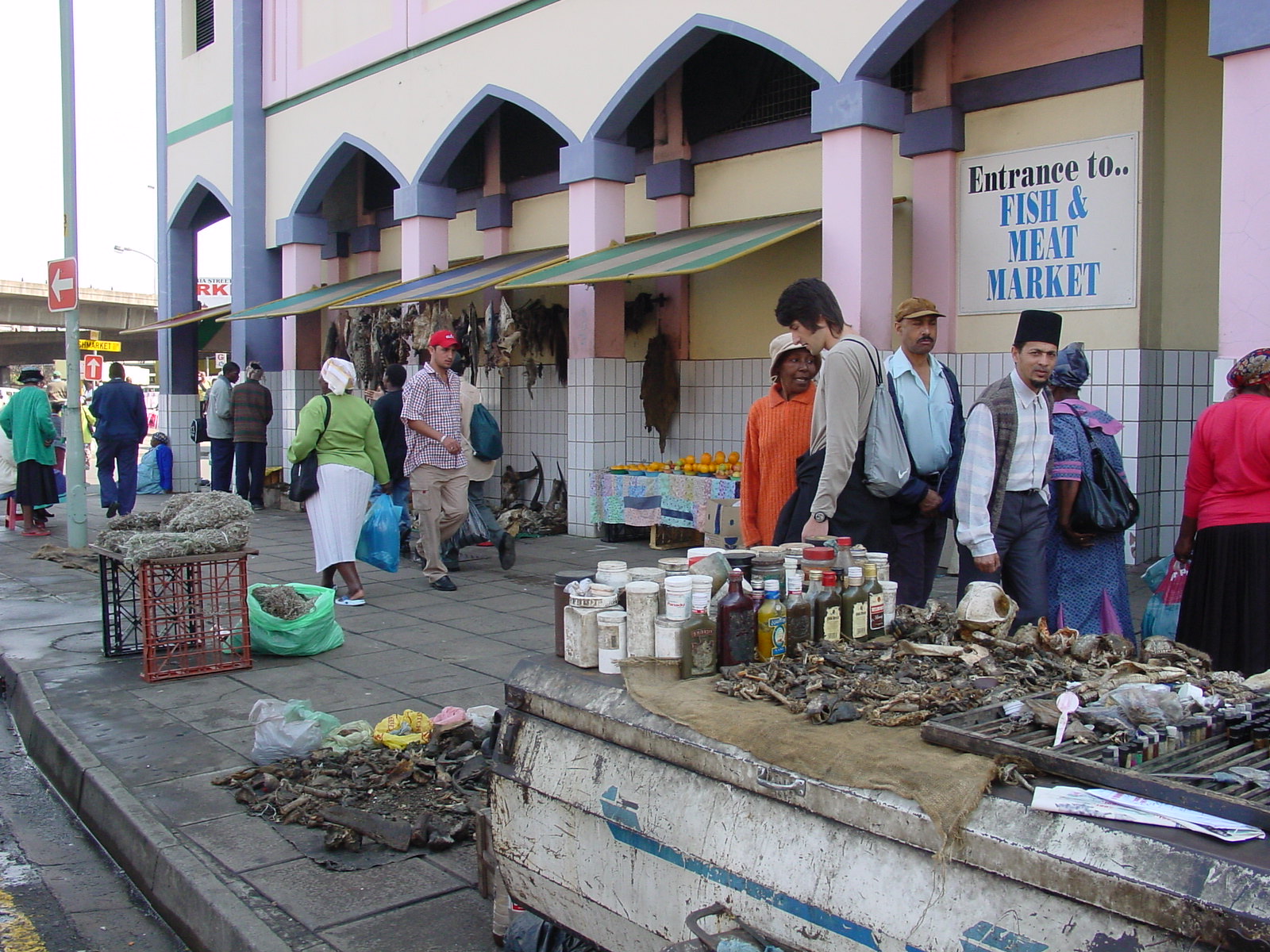
Getting beyond the formal/informal divide
A stark line is sometimes drawn between ‘industrial/commercial’ and ‘informal’ segments of South Africa’s meat industry. But are such distinctions helpful?
5 December 2025 - Amber Huff & Linda Pappagallo
Exploring rangeland myths in 2026
Through 2026, the REPAiR is hosting a series of activities that explore ‘rangeland myths’ in global perspective. We offer an open invitation to get involved, share your experiences and stories, and help us to rethink what we think we know about rangelands and pastoralism.