

7 October 2026
Green Desertification – Perspectives on the Tunisian Steppe
By Ali Hanafi, Irène Carpentier, Hassen Ouerghemmi
Translation and pictures by Linda Pappagallo
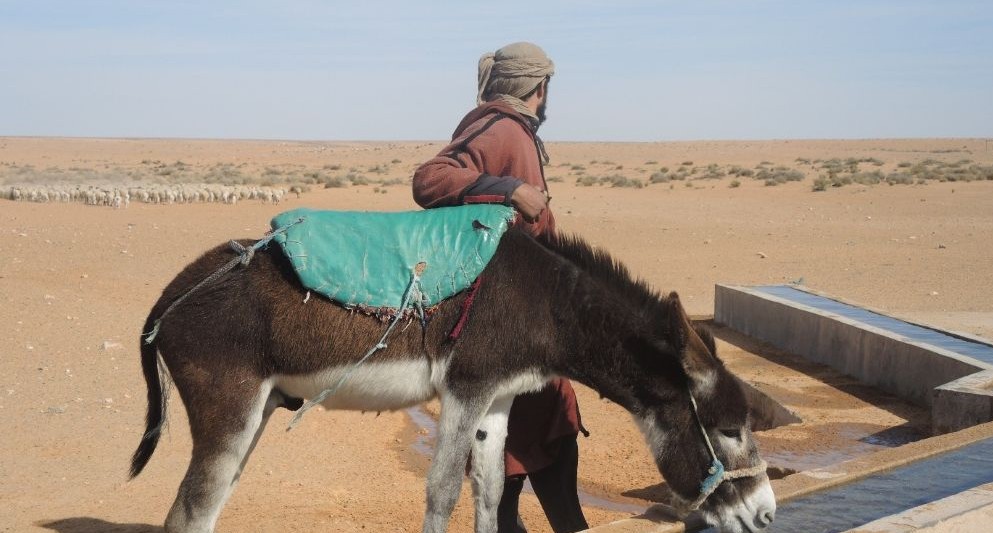
In southeastern Tunisia, where the Jeffara Plain meets the first foothills of the Matmata Mountains, the landscape is disconcerting. It bears little resemblance to the image most people have of a fertile land. The steppe is sparse, the soil is often bare, and the vegetation appears stunted. To the hurried tourist or the visiting expert, this scenery seems to depict a territory in distress. Such aridity is often perceived as degradation—a condition that must be cured with a universal remedy: greening.
Yet in this arid steppe, it is precisely this greening that has become the source of ecological imbalance. It lies at the heart of policies aimed at « mise en valeur » (land improvement, but literally “adding value”) and “development,” which have frequently produced outcomes opposite to those they promised. Aridity is not a pathology; it is an environmental context shaped by millions of years of evolution.
From pastoral biodiversity to productive greening
In regions where rainfall is measured in mere millimetres and may fluctuate threefold from one year to the next, dense and permanent vegetation would be biologically absurd. The plants that survive here, chamaephytes such as wormwood (Artemisia) and Rhanterium have opted for discretion, their apparent scarcity is a strategy not a failure of adaptation. Their spacing allows each plant to capture scarce water resources, withstand strong winds, and avoid exhausting fragile soils.
For decades, we have “labouré” (ploughed, literally laboured) these lands. We have sown them with cereals according to the uncertainties of rainfall.
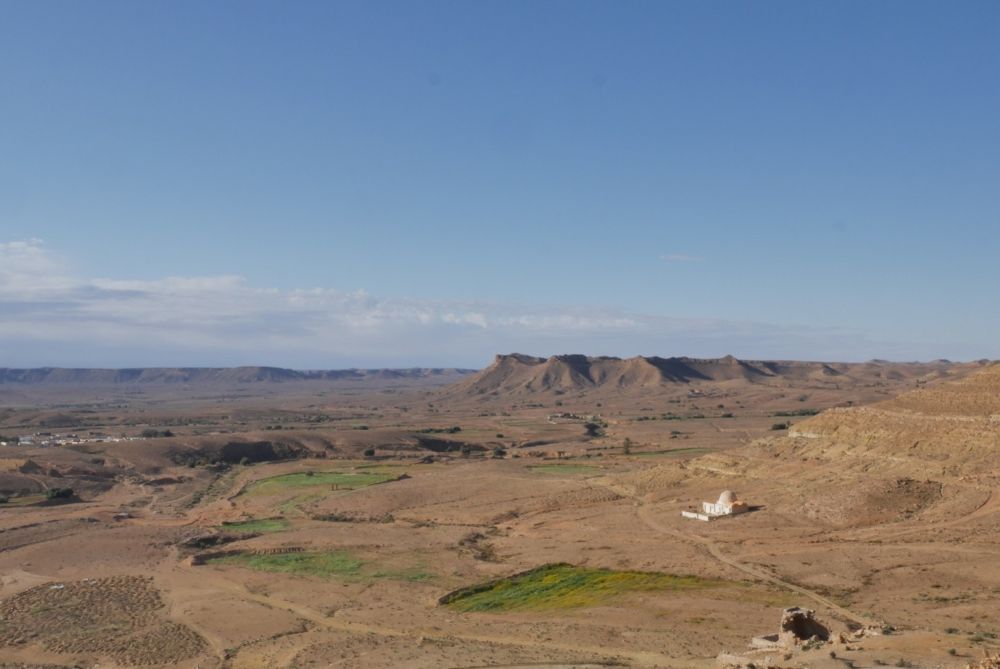
Today, we plant olive trees in dense, orderly rows. For planners, planting a tree has come to symbolize “adding value,” developing, and therefore restoring the land.
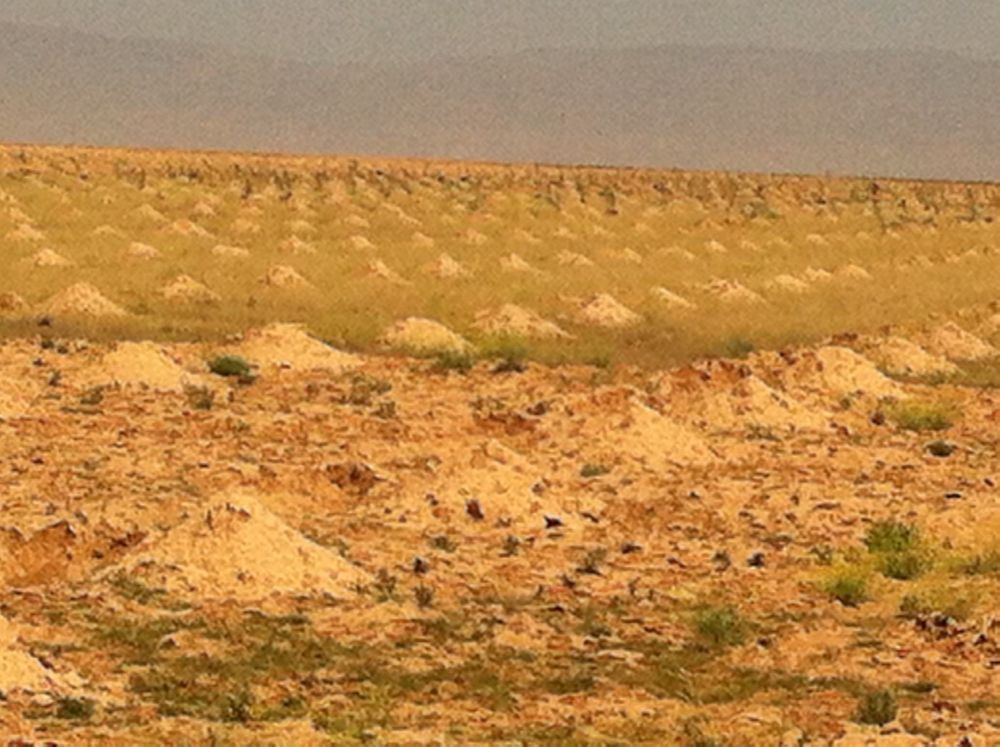
Yet the myth of the olive grove as the cure for desertification has had devastating consequences, as subtle as they are profound.
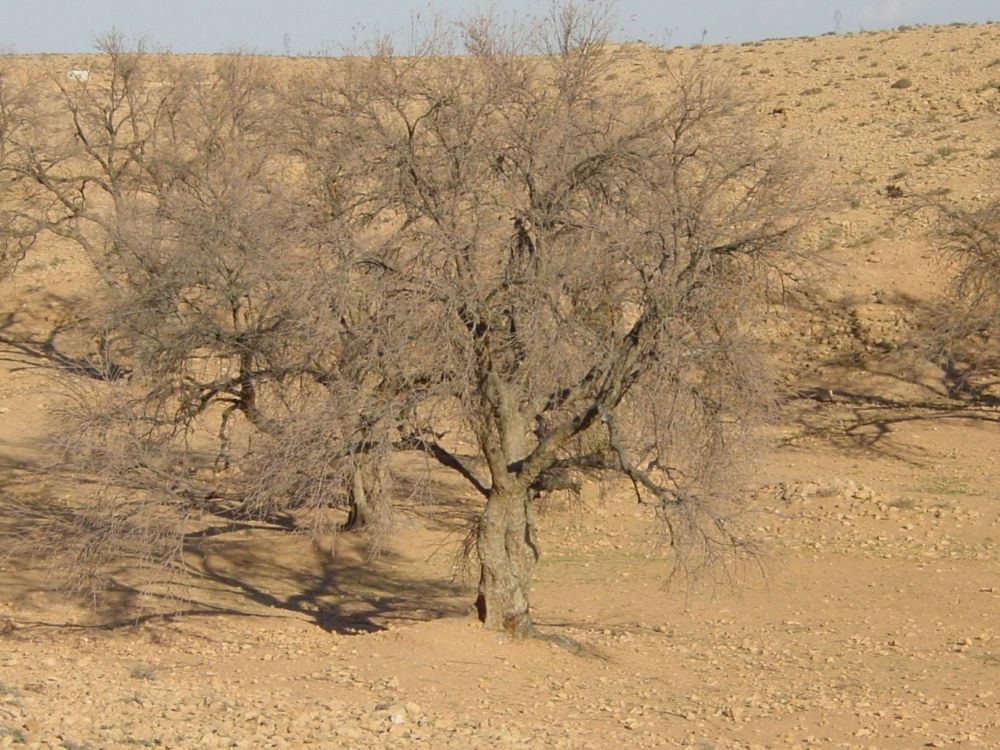
In these gypsum-rich environments, where groundwater resources are already under severe pressure, irrigated olive cultivation is not a promise but a trap. Intensive irrigation extracts fossil groundwater, wells multiply, aquifers decline, and the increasingly saline water eventually sterilizes the soil. Gradually, white salt crusts replace the brown steppe.
This form of greening creates an agricultural desert: a landscape dependent on external inputs and incapable of regenerating itself. An arid region cannot be irrigated in the same way as a field in northern Tunisia. Water is too precious, and ecological balances are too fragile.
Where once there was a living steppe -poor in vegetation cover but rich in biodiversity – there is now often a monoculture of irrigated olive trees, frequently of Spanish varieties. Pastoral biodiversity collapses. The grasses once favoured by grazing animals – fine graminaceous species that nourished livestock without degrading the soil – disappear. They are replaced by thorny shrubs of little forage value or replaced by species typical of disturbed soils.
The “green” of the olive grove has erased the silvery-green hues of the steppe; the discreet vegetation that once sheltered hundreds of plant species across a single hillside.
Beyond Green: the genius of pastoralism
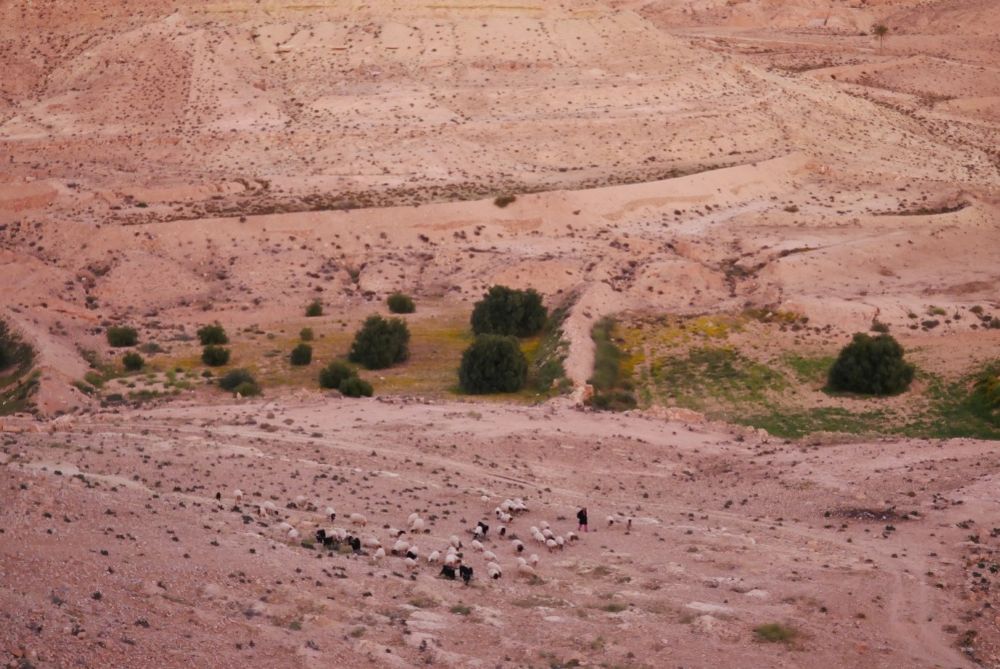
To understand this quiet transformation, we must accept a challenging idea: in arid environments, the health of an ecosystem is not measured by the density of its vegetation or the intensity of its plantations, but by its capacity to endure environmental uncertainty.
A healthy rangeland is not an English lawn. It is a mosaic in which bare patches are not “dead” spaces; they function as runoff collection areas, channelling scarce rainfall toward clumps of vegetation. This landscape reflects a form of collective ecological intelligence, forged through millennia of co-evolution between climate, plants, people, and animals.
It is here that pastoralism embodies a fundamentally different way of understanding the world. Long dismissed as an archaic or even destructive activity, mobile and extensive livestock herding is in fact one of the very few sustainable ways of using arid lands. Pastoralists do not remain in one place. They move, following rainfall, new vegetation growth, and water sources. This mobility is their genius. It allows vegetation to rest, regenerate, and become productive once again. The herd is not a predator of the environment; it is a tool for maintaining it, when mobility remains possible.
In short, what destroys the steppe is not the repeated passage of livestock, but their confinement. Fences, irrigated perimeters, privatized land, and expanding olive plantations—what restricts pastoral mobility, transforms living rangelands into overexploited landscapes. Deprived of the ability to move, herders have little choice but to concentrate their animals within limited areas. Localized overgrazing is therefore less the consequence of pastoralism itself than of its disappearance.
Agricultural greening in arid environments cannot rely on sedentary, intensive farming models simply traced onto arid landscapes from humid regions. It must learn to compose with scarcity, to move with its rhythms, leaving spaces of freedom, corridors of movement, and years of fallow. It must accept that production will be intermittent, that yields will fluctuate, and that uncertainty is not an exception but the norm. It is through this delicate balance that livestock production, crop cultivation, and soil conservation can be reconciled.
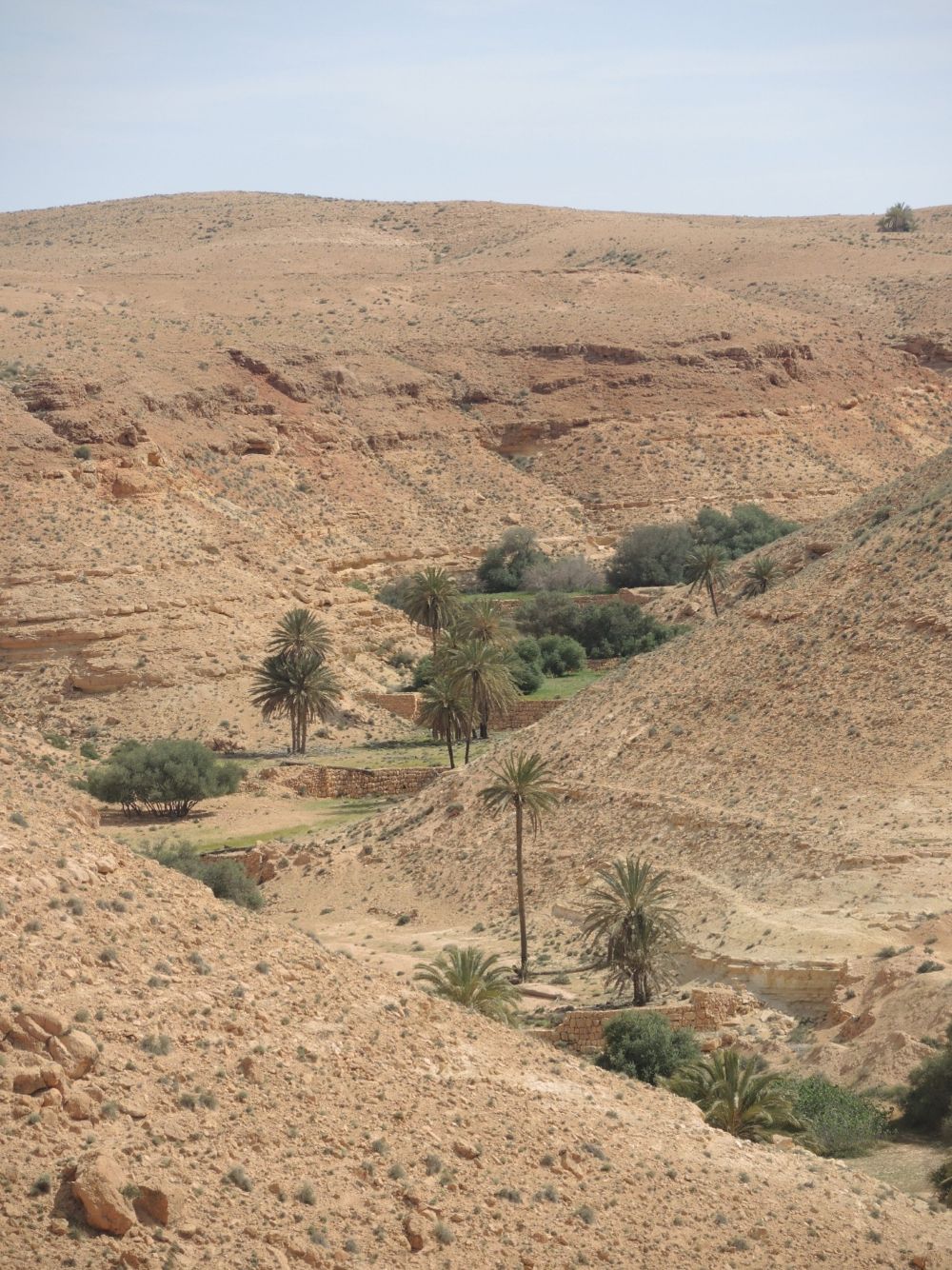
The traditional agropastoral systems of the Jeffara had long understood this principle. They combined rain-fed cereals—particularly barley and durum wheat—with small fruit orchards and mobile livestock herds. Nothing was monochrome. Everything was complementary.
To look at the steppe through the eyes of a pastoralist is to learn to see beyond green. It is to notice a tuft of Stipa grass surviving the drought, a small shrub relished by camels, or an ephemeral flower that emerged after last weeks’ rainfall. It is to understand that the bare soil beneath one’s feet is not sterile, but holds dormant seeds waiting for favourable conditions to germinate. This ecological memory, this biological patience, is the true wealth of arid lands. Forced greening, it is this, that merely brutalises these slow and resilient processes.
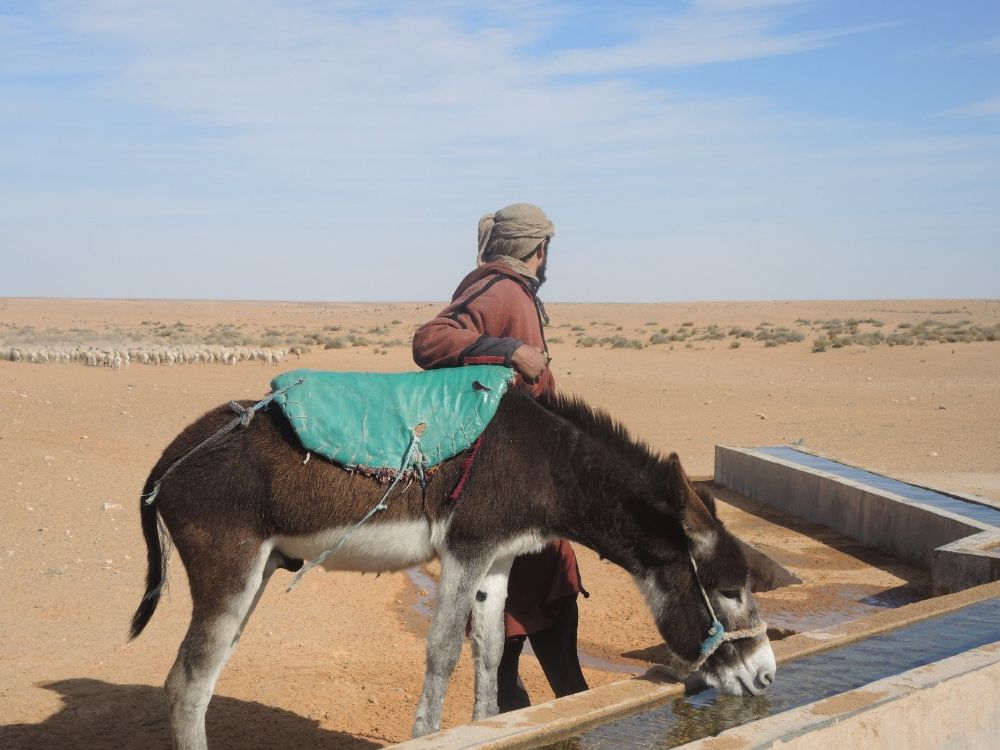
Beyond agriculture, the greening paradigm reflects a broader discourse rooted in both colonial and capitalist imaginaries. From the political slogan of “making the desert bloom” to extractive mining projects, military experimentation, and large-scale photovoltaic parks, deserts are rarely acknowledged for their own ecological value. As Brahim El Guabli argues, Saharanism operates as a racialized and extractive imaginary that legitimizes external forms of control by reducing complex relationships between people and their environments to mere resources for exogenous development.
Research and development in arid lands: rethinking ecological restoration as the only horizon
Rangelands cover nearly half of the Earth’s terrestrial surface. They are not empty, lifeless spaces waiting to be “filled,” “greened,” or “restored.” They are complex territories, governed by their own ecological dynamics, vulnerabilities, and forms of ingenuity. Pastoral communities have lived in these environments for centuries, developing bodies of knowledge that agronomists and other experts often discover late, knowledge that public authorities have overlooked in their efforts to control these vast landscapes, now situated within the frontiers of modern nation-states.
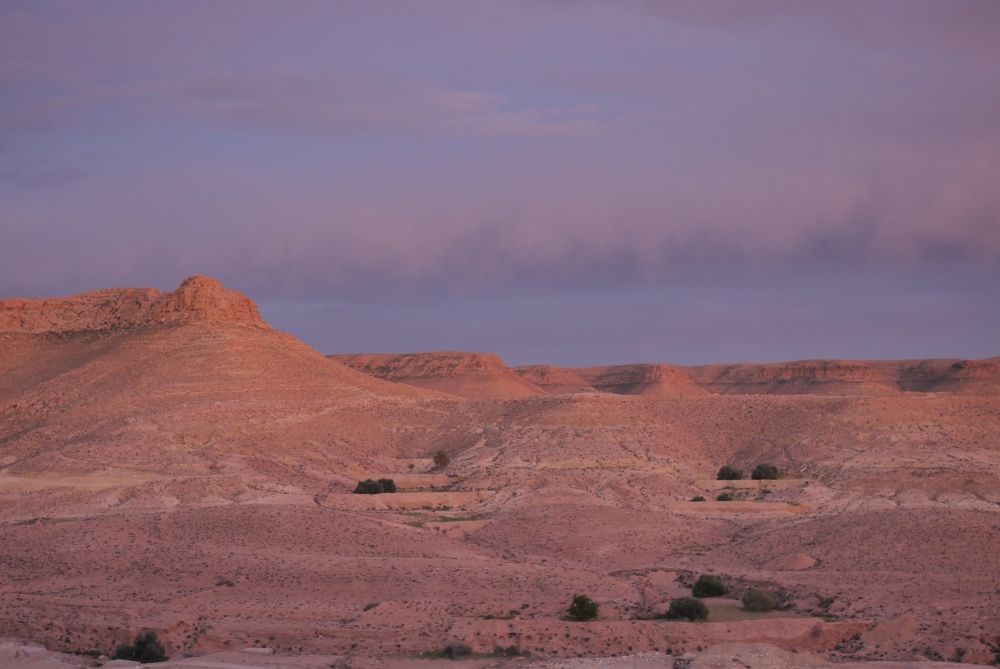
Rethinking the supposed “degradation” of arid steppes therefore begins with dismantling an aesthetic, political, and scientific myth. In the desert, the spectacular flush of flowers that follows a rare rainfall may be visually striking, but sustainability does not lie in these brief displays. It resides instead in the ecosystem’s capacity to recover, and in deciphering the subtle adaptive practices.
The indicators of health of arid ecosystems, including its rangelands, should not be assessed by the extent of agricultural greening or by simple measures of vegetation recovery. Rather, it depends on the collective maintenance of diverse communities of perennial plant species through the movement of herds; on the soil’s ability to capture and retain rainfall when it falls; and on the freedom of livestock to move across the landscape and make use of the distinctive opportunities offered by these pastoral production systems.
If we genuinely seek to restore ecological balance, we must stop imposing external development models and instead recognize the unique historical trajectories and ecological dynamics of these remarkable landscapes. Pastoralists have long understood that green vegetation alone is no guarantee of survival, and that projects of “mise en valeur” often serve primarily to regulate mobility, expand costly infrastructures, and establish new institutional arrangements.
The dominant narrative of desertification is itself produced and reinforced through powerful cultural practices. Satellite imagery and “before-and-after” photographs of greening have become persuasive visual evidence of environmental recovery. Tree planting is celebrated as a visible and linear solution to what is likewise imagined as a linear process of degradation. Yet this visual culture obscures the irregular, fragmented, and seasonal dynamics that characterize arid ecosystems, privileging an aesthetic spectacle over ecological function.
These narratives are further sustained by institutional practices. Forestry departments, land-mapping exercises, and international development organizations that often require standardized indicators and “scalable solutions”. This bureaucratic logic simplifies the intricate mosaics of pastoral landscapes into administratively manageable grids, making intervention appear not only feasible but necessary for reporting requirements and funding cycles.
Challenging the myth of greening does not mean denying that environmental change is occurring. Rather, it calls for broadening the evidence base. This means bringing together insights from the ecology of arid lands, including non-equilibrium theories that reject the notion of a single stable ecological state, with environmental history, political ecology, and the environmental humanities.
Such a shift in perspective moves attention away from symbolic greening and toward more fundamental questions: governance, water rights, long-term stewardship, and locally negotiated management of landscape diversity. Instead of merely counting trees, it asks who makes decisions, whose interests they serve, and how the political economy of environmental interventions shapes both landscapes and livelihoods.
Ultimately, greening the desert is not a remedy; it may instead represent the danger of applying a generic solution to the profound transformations affecting arid steppes. The real challenge is to learn how to read what is already there—to recognize that the health of a landscape cannot be reduced to a colour, but is rooted in a history of shifting ecological balances, quiet adaptations, and practical knowledge. The untrained eye searches for green. The pastoralist’s gaze searches for life where others fail to see it.
Selected references
Genin D., Hanafi A., 2010. Estimation of pastoral pressure on arid rangelands: how to take into account herd management methods? Livestock Research for Rural Development, Vol. 22 (4): 9p
Hanafi A., 2022. Land Cover/Land Use Dynamics in Arid Mediterranean Fragile Ecosystems and its implications on Economic and Environmental Imbalances, southern Tunisia. International Journal of Environmental & Agriculture Research, Vol-8, Issue-5, pp: 30-5
Hanafi A., 2023. The sustainability of Tunisian arid food systems between the limits of environmental supply and the challenges of food security for rural populations. Case of cereal farming. International Journal of Agriculture and Environmental Research, Vol. 09, Issue 04, pp: 667-716, ISSN: 2455-6939
Hanafi A., Jauffret S., 2008. Are long-term vegetation dynamics useful in monitoring and assessing desertification processes in the arid steppe, southern Tunisia. Journal of Arid Environments, Vol. 72: 557–572. Elsevier
Experimental Saharanism: Exploiting desert environments – The Markaz Review

La désertification verte – Regards sur la steppe tunisienne
Dans le sud-est de la Tunisie, là où la Jeffara rejoint les premiers reliefs de Matmata, le paysage déconcerte. Il ne ressemble en rien à l’image qu’on se fait d’une terre fertile. La steppe est clairsemée, le sol souvent à nu, la végétation paraît chétive. Pour le touriste pressé ou l’expert venu d’ailleurs, ce décor semble être celui d’un territoire en souffrance. Cette aridité serait une dégradation, une maladie qu’il faudrait guérir avec un remède universel : le verdissement.
Pourtant, dans cette steppe aride, c’est précisément ce verdissement qui est la cause des déséquilibres. C’est le projet central des politiques de « mise en valeur » et de “développement” qui ont souvent produit l’inverse de ce qu’elles promettaient. L’aridité n’est pas une pathologie, c’est un contexte façonné par des millions d’années d’évolution.
De la biodiversité pastorale au verdissement productif
Dans les régions où les précipitations se comptent en millimètres et varient du simple au triple d’une année sur l’autre, une végétation dense et permanente serait biologiquement absurde. Les plantes qui y survivent – ces chaméphytes comme l’Armoise ou le Rhanterium – ont opté pour la discrétion, mais leur rareté est une stratégie, pas un échec. Leur espacement permet à chacune de capter l’eau rare, de résister au vent, de ne pas épuiser un sol fragile. Depuis des décennies, on a labouré ces terres. On y a semé des céréales au gré des aléas. Mais désormais on y plante des oliviers en rangs serrés. Pour les planificateurs, planter un arbre signifiait “mettre en valeur”, développer, donc restaurer. Ce mythe de l’oliveraie comme remède à la désertification a eu des effets dévastateurs, aussi discrets que profonds. Car dans ces milieux gypseux, sur ces nappes phréatiques déjà menacées, l’olivier irrigué n’est pas une promesse mais un piège. L’irrigation intensive pompe l’eau fossile, les puits se multiplient, la nappe baisse, et l’eau devenue trop salée finit par stériliser les sols. Les croûtes blanches de sel remplacent alors peu à peu la steppe brune. Ce verdissement est un désert agricole, dépendant des intrants, incapable de se régénérer seul. En effet, on n’arrose pas une zone aride comme on arrose un champ dans le nord du pays. L’eau y est trop précieuse, les équilibres trop fragiles. Là où l’on avait une steppe vivante, pauvre en couvert mais riche en espèces, on se retrouve souvent avec une monoculture d’oliviers de variété espagnols en irrigué. La diversité pastorale s’effondre. Les plantes appréciées des troupeaux – ces graminées fines qui permettaient aux animaux de se nourrir sans abîmer le sol – disparaissent. À leur place viennent des espèces épineuses, sans intérêt fourrager, ou des plantes indicatrices de sols retournés. Le « vert » de l’oliveraie a effacé le vert-argenté de la steppe, celui qui, discret, abritait une centaine d’espèces sur une même colline.
Au-delà du vert, le génie pastoral
Pour comprendre cette mutation silencieuse, il faut accepter une idée dérangeante : dans les milieux arides, la santé d’un écosystème ne se mesure pas à l’intensité de ses plantations, mais à sa capacité à durer face aux aléas. Un bon parcours n’est pas un gazon anglais, c’est une mosaïque où les zones dénudées ne sont pas « mortes » : elles servent de lits de ruissellement, concentrant l’eau rare vers les touffes de végétation. C’est une intelligence collective, issue de millénaires de coévolution entre le climat, les plantes, les hommes et les animaux. C’est ici que le pastoralisme incarne une autre façon de voir le monde. Longtemps caricaturé comme une activité archaïque, voire destructrice, l’élevage mobile et extensif est en réalité l’une des rares formes d’utilisation des terres arides qui soit durable. Les pasteurs ne restent pas en place, ils se déplacent, suivent les pluies, les repousses, les points d’eau. Cette mobilité est leur génie. Elle permet à la végétation de se reposer, de se régénérer, de produire à nouveau. Le troupeau n’est pas un prédateur du milieu : il est un outil d’entretien, à condition que la marche reste possible.
En somme, ce qui tue la steppe, ce n’est pas le passage répétitif des animaux, mais c’est leur enfermement. Les clôtures, les périmètres irrigués, les terres privatisées, les plantations d’oliveraies : tout ce qui entrave la mobilité pastorale transforme des parcours vivants en espaces surexploités. Privé de sa capacité à bouger, l’éleveur n’a plus d’autre choix que de concentrer ses bêtes sur un petit territoire. Le surpâturage localisé n’est pas tant la faute du pastoralisme, que celle de sa disparition. Le verdissement agricole en milieu aride ne peut pas être celui d’une agriculture sédentaire intensive, calquée sur des modèles humides. Elle doit composer avec la rareté, laisser des espaces de liberté, des corridors de passage, des années de jachère. Elle doit accepter que la production soit intermittente, que les rendements varient, que l’incertitude soit la règle. C’est par cet équilibre subtil que l’on peut concilier élevage, culture et préservation des sols. Dans la Jeffara, les systèmes agropastoraux traditionnels l’avaient compris : ils associaient céréales pluviales (orge, blé dur), arbres fruitiers en petites parcelles, et troupeaux en mouvement. Rien n’y était monochrome. Tout y était complémentaire. Regarder une steppe avec les yeux d’un pasteur, c’est apprendre à voir au-delà du vert. C’est remarquer une touffe de Stipa qui résiste à la sécheresse, un petit arbuste que les chameaux apprécient, une fleur éphémère née d’une pluie tombée la semaine dernière. C’est savoir que le sol nu sous ses pieds n’est pas stérile : il porte des graines en dormance, prêtes à germer quand les conditions redeviennent favorables. Cette mémoire du sol, cette patience biologique, sont la vraie richesse des zones arides. Le verdissement forcé, lui, ne fait que brutaliser cette lenteur.
Au-delà de l’agriculture, ce prisme du verdissement reflète un discours plus large, à la fois colonial et capitaliste. Du slogan politique « faire fleurir le désert » aux logiques extractives liées à l’exploitation minière, aux expérimentations militaires ou aux parcs photovoltaïques, les déserts sont rarement reconnus pour leurs propres écologies. Comme le souligne Brahim El Guabli, le “saharanisme” fonctionne comme un imaginaire racialisant et extractif qui justifie des formes de contrôle extérieur, réduisant des relations homme-environnement complexes à de simples ressources destinées à des projets exogènes.
La recherche & développement sur les zones arides en échec, déconstruire la régénération écologique comme seul horizon
Les parcours couvrent près de la moitié des terres émergées. Ils ne sont pas des espaces vides, morts, en attente d’être « remplis », « verdis », ou “régénérés”. Ce sont des territoires complexes, avec leurs règles, leurs fragilités et leurs génies. Les communautés pastorales qui y vivent depuis des siècles détiennent des savoirs que nos agronomes et autres experts redécouvrent parfois avec retard, et que les pouvoirs publics ont ignorés, pour mieux dominer ces grandes portions de territoires, désormais frontalières des états nations. Dès lors, repenser la « dégradation » des steppes arides, c’est d’abord déconstruire un mythe esthétique, politique, et scientifique. Dans le désert, une floraison éphémère après une pluie peut être impressionnante mais la durabilité n’est pas dans l’éclat, mais la capacité à rebondir, et à décrypter les pratiques subtiles d’adaptations. Les indicateurs de santé d’un parcours aride ne sont donc pas dans son verdissement agricole, ou sa régénération végétale, mais plutôt l’entretien collectif d’une diversité d’espèces pérennes de qualité par le passage des troupeaux, dans le maintien de l’aptitude du sol à retenir l’eau quand elle tombe, dans la liberté laissée aux troupeaux de se déplacer et de tirer parti des opportunités de valorisation de la qualité unique de ces systèmes d’élevage. Si l’on veut vraiment restaurer les équilibres, il faut cesser d’imposer des modèles extérieurs pour mieux prendre en compte les trajectoires et dynamiques uniques de ces espaces si particuliers. Les pasteurs savent depuis longtemps que le vert n’est pas gage de survie, et que les projets de “mise en valeur” sont avant tout des projets de régulation de la mobilité, de développement d’infrastructures coûteuses, et de nouveaux arrangements institutionnels.
Le récit de la désertification est produit et renforcé par des formes culturelles puissantes : analyses satellitaires et images de verdissement « avant/après ». La plantation d’arbres est valorisée comme une réparation visible et linéaire d’un processus lui-même imaginé comme une dégradation linéaire. Pourtant, cette culture visuelle efface les dynamiques irrégulières, fragmentées et saisonnières des milieux arides, privilégiant le spectacle esthétique au détriment des fonctions écologiques. Ces récits sont renforcés par des pratiques institutionnelles : services forestiers, exercices de cartographie et organisations internationales qui ont besoin d’indicateurs lisibles et de solutions reproductibles à grande échelle. Cette logique bureaucratique simplifie des mosaïques pastorales complexes en grilles administrables, rendant l’intervention non seulement possible, mais apparemment nécessaire pour les cycles de reporting et de financement. Contre le mythe du verdissement, il ne s’agit pas de nier les transformations environnementales. Il s’agit plutôt d’élargir les bases de preuve : en combinant l’écologie des zones arides (y compris les approches non-équilibrées qui rejettent l’idée d’un état stable unique) avec l’histoire environnementale, la political ecology et les humanités environnementales. Ce changement de perspective déplace les priorités du verdissement symbolique vers des questions de gouvernance, de droits à l’eau, d’entretien et de gestion localement négociée de la diversité paysagère, au-delà des simples comptages d’arbres pour interroger l’économie politique des décisions et des bénéficiaires.
En somme, verdir le désert n’est pas le remède mais peut incarner la menace d’une réponse générique aux transformations profondes des steppes arides. C’est d’apprendre à lire ce qui est déjà là. C’est accepter que la santé d’une terre ne se résume pas à une couleur, mais à une histoire d’équilibres mobiles, d’adaptations silencieuses et de savoirs pratiques. L’œil du novice cherche la couleur. Le regard du pasteur, lui, cherche la vie là où on ne l’attend pas.
Quelques références bibliographiques
Genin D., Hanafi A., 2010. Estimation of pastoral pressure on arid rangelands: how to take into account herd management methods? Livestock Research for Rural Development, Vol. 22 (4): 9p
Hanafi A., 2022. Land Cover/Land Use Dynamics in Arid Mediterranean Fragile Ecosystems and its implications on Economic and Environmental Imbalances, southern Tunisia. International Journal of Environmental & Agriculture Research, Vol-8, Issue-5, pp: 30-5
Hanafi A., 2023. The sustainability of Tunisian arid food systems between the limits of environmental supply and the challenges of food security for rural populations. Case of cereal farming. International Journal of Agriculture and Environmental Research, Vol. 09, Issue 04, pp: 667-716, ISSN: 2455-6939
Hanafi A., Jauffret S., 2008. Are long-term vegetation dynamics useful in monitoring and assessing desertification processes in the arid steppe, southern Tunisia. Journal of Arid Environments, Vol. 72: 557–572. Elsevier
Experimental Saharanism: Exploiting desert environments – The Markaz Review
Related content
1 June 2026 Jeremy Allouche & Linda Pappagallo
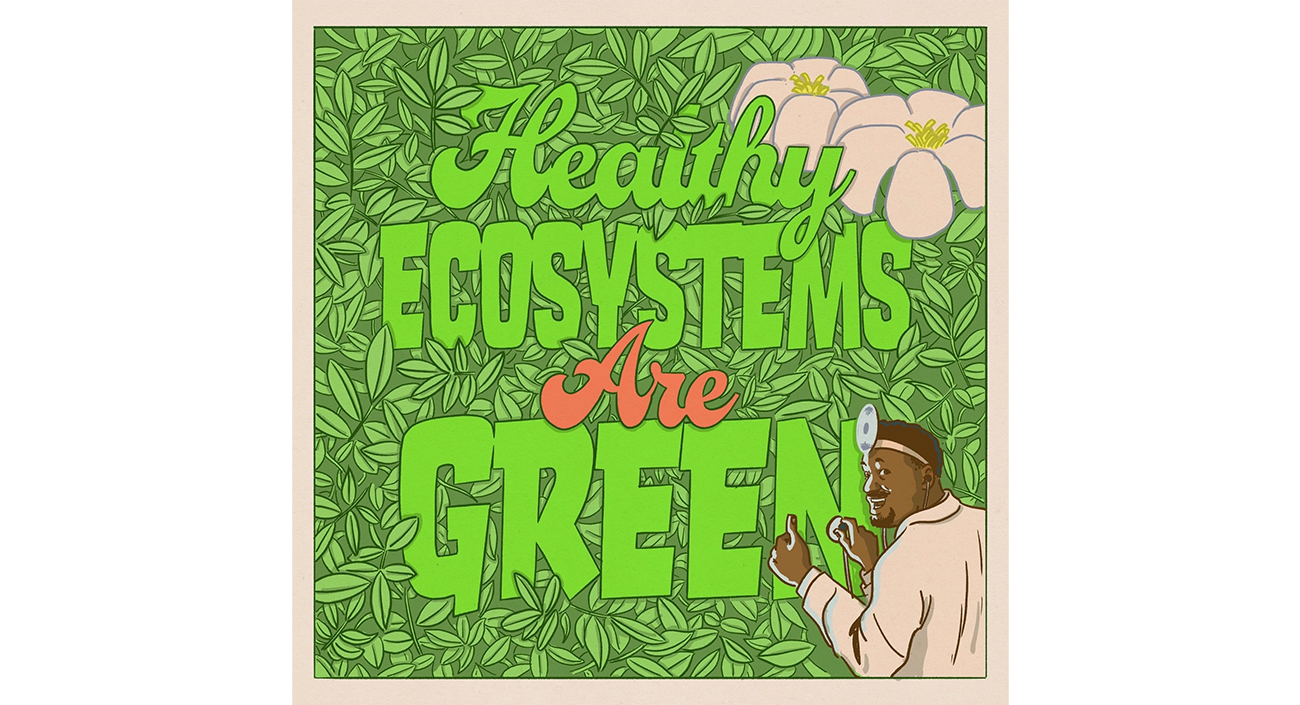
Myth: ‘Healthy ecosystems are green’
The idea that ‘green’ ecosystems are automatically more healthy is based on a long history of assumptions about nature.

31 May 2026 Linda Pappagallo
Podcast: Deserts, Saharanism and ‘green’ landscape myths
An interview with Brahim El Guabli about the origins and legacy of bias against deserts in colonial science and culture, and the myth of the default ‘green’ landscape.

5 December 2025 Amber Huff & Linda Pappagallo
Exploring rangeland myths in 2026
Through 2026, the REPAiR is hosting a series of activities that explore ‘rangeland myths’ in global perspective. We offer an open invitation to get involved, share your experiences and stories, and help us to rethink what we think we know about rangelands and pastoralism.