

28 April 2026 Linda Pappagallo
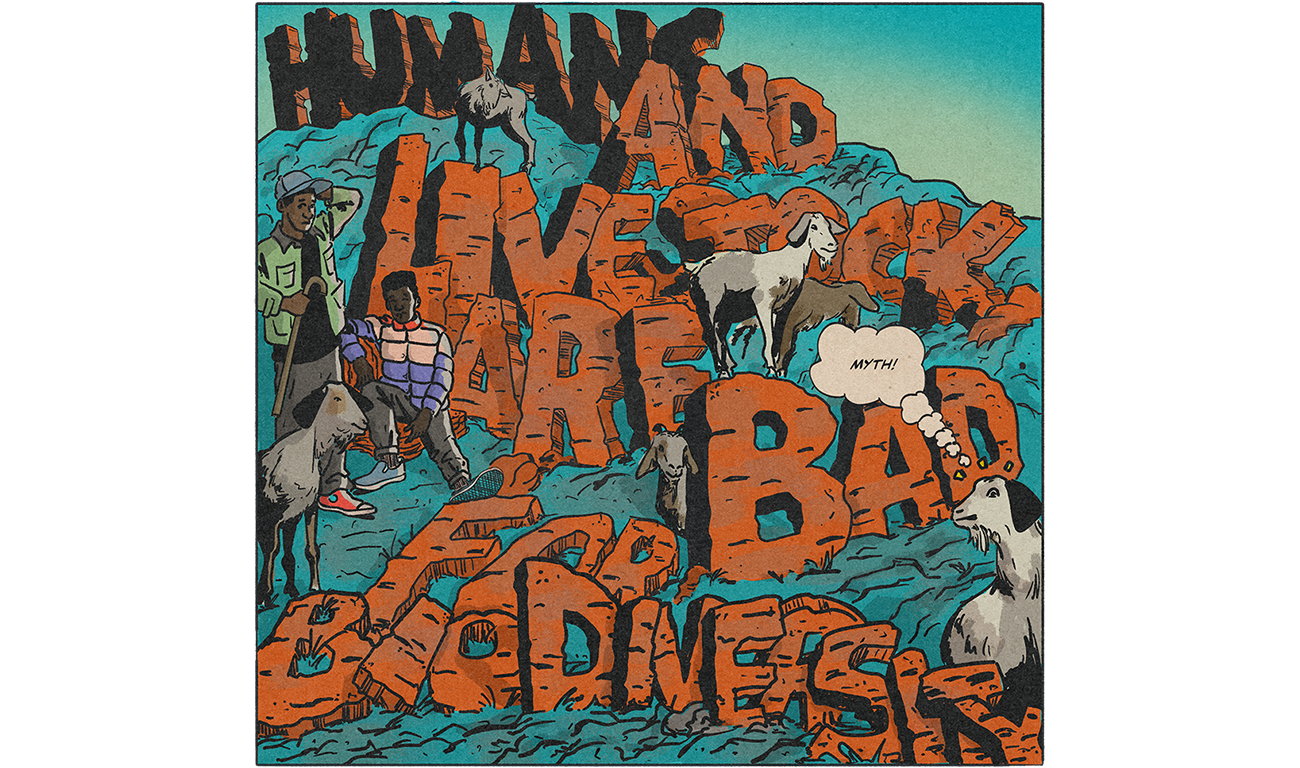
Myth: ‘People and livestock are bad for biodiversity’
Beyond myths based on stories of lost Paradise or a romantic wilderness, there are diverse ways of seeing the relationships between humans, livestock and wildlife.

Few would dispute that extractive industries or war are deeply harmful to biodiversity, but there is far less agreement on the more subtle (yet widely assumed and far too simplistic) claim that people and livestock are bad for biodiversity.
‘People’, of course, do not all behave the same, and nor do livestock. People and livestock can act as stewards of landscapes or agents of degradation. But do these outcomes depend on numbers, concentrations and growth rates of humans or livestock, or do ecological outcomes depend on management, behaviour and governance? Or both?
The critical question, then, may not be whether people or livestock are bad for biodiversity; but whether and how people and livestock are organized in relation to land, resources and ecosystems in particular settings, and how this interacts with and shapes biodiversity in global rangelands. As the phrase puts it: it’s not the cow, but the how.
In this think piece, we explore how this myth about people and livestock being inherently bad for biodiversity trickles down from misleading assumptions on baseline ideals, values about ‘nature’ and stewardship, to paradoxical outcomes in conservation.

How the myth trickles down
The origins of the myth is deeply rooted in baseline imaginaries of what healthy or pristine ecosystems look like. Baselines, in fact, influence everything from environmental laws to climate policy.
But to understand how the ‘people and livestock are bad for biodiversity’ myth trickles through space and time, let’s start from what is known as ‘the Anthropocene’, which describes the historical moment in which human activity became the dominant force shaping the Earth system, altering climate and ecosystem functioning, and accelerating biodiversity loss. Jason Moore prefers to use the term Capitalocene. Moore argues that the Anthropocene framing attributes responsibility to ‘humanity’ as a whole, whereas the Capitalocene highlights the political-economic drivers of change: how people govern, how they organize and exploit ‘nature’. Moore brings the focus onto capitalism’s defining features – accumulation, profit maximization and growth dependence – as the forces central to ecological breakdown.
Meanwhile, in the book A Billion Black Anthropocenes, Kathryn Yusoff argues that “as the Anthropocene proclaims the language of species life — Anthropos — through a universalist geologic commons, it neatly erases histories of racism”. Yusoff writes about how “the invasion of the ‘New World’ produced the first geologic subjects of the Anthropocene, and they were indigenous and black”. In other words, ecological crisis is not about humans but race-based colonial and settler practices. In The Ecology of Freedom, Murray Bookchin instead shows how ecological crisis stems from “the domination of human by human” – an “ideology that ‘man’ is destined to dominate ‘Nature’” which is reproduced by the “strident fetishization” of wilderness, “as distinguished from humanly altered areas of the planet”.
Whichever way you cut the cake, biodiversity loss is not simply the result of human presence, but of how power structures economies, societies and governance in different contexts.
How is grazing coupled with ecological feedback?
This same argument can be made when talking about the relationship between livestock and biodiversity loss. Take different grazing systems – ways in which livestock are choreographed to interact with grass/fodder to produce meat, milk and so on – and how human labour (including herding) is organized around livestock management. Different ways of choreographing livestock have fundamentally different impacts on ‘biodiversity’.
When ‘extensive’, mobile pastoral systems are closely embedded in ecosystem processes, they contribute to mosaics of habitat and ecosystem service provision. By contrast, feedlots, continuous grazing systems, as well as grid-based rotational grazing systems, tend to simplify landscapes and ‘decouple’ grazing from ecological feedbacks. This can affect biodiversity negatively, or at least fail to support its flourishing.
This distinction in livestock production systems, the way inputs and outputs are organized, underscores the broader point we are making in this think piece. It is not ‘human’ use or ‘livestock’ in itself that determines ecological outcomes, but the way socio-ecological systems are organized and managed.
While this may seem obvious and simple, the idea that people and livestock are inherently bad for biodiversity remains implicitly (and sometimes explicitly) a cornerstone of many conservation efforts. It surfaces in familiar narratives: that environmental degradation is driven by poverty, rather than by wealth, overconsumption or infrastructure development that disrupt the interdependencies between water management practices and ecosystem integrity. It reappears in the tired trope of Malthusianism that explains environmental and human crisis as caused by population growth; or that the primary causes of deforestation are ‘slash-and-burn’ farming; that rangeland degradation is driven by overgrazing or overharvesting; and that Indigenous diets and subsistence hunting threaten biodiversity because of unsustainable practices.
While all of these can affect biodiversity, various people-centered interpretations of ecological decline are often deeply rooted in the enduring myth of the Tragedy of the Commons, as we have already explored: a powerful and persistent logic that frames shared resource use as inevitably leading to overexploitation. Within this framing, degradation and biodiversity loss become inevitable, and exclusion or privatisation appear as the most ‘rational’ solutions.
Who is affected most by the myth?
From here, a series of seemingly logical conclusions follow: that landscapes must be ‘restored’ by removing people and livestock; that resource use must be restricted, that for rewilding to work we must empty landscapes of human presence; that biodiversity is safeguarded by expanding protected areas (rather than connecting them); and finally that stewardship must be regulated, whether by states, markets or traditional authorities.
Such paternalistic views give way to a series of questionable top-down, surveillance-based, rigid and control-oriented conservation strategies – approaches that risk overlooking diverse knowledge, values and worldviews in the relationships between people, livestock and biodiversity. Landscapes are simplified, local knowledge is sidelined, and complex socio-ecological relationships are reduced to single variables, like human and livestock pressures, that need to be controlled.
The result is ecological misdiagnosis, and in the most extreme cases displacement and eviction, accompanied by the growing militarization of conservation landscapes.
As this myth trickles down from ‘higher-level’ assumptions to local contexts and practices, it disproportionately affects small-scale, extensive, and flexible practices like transhumance, gathering, and agroforestry – livelihoods that are most rooted in ecosystems.
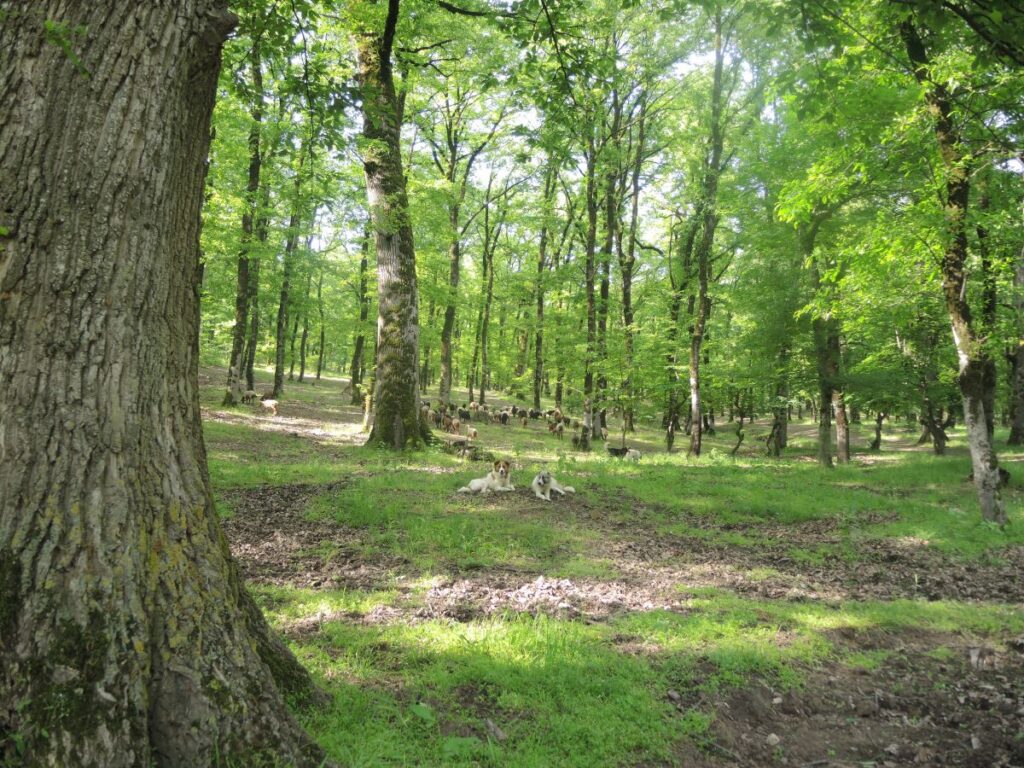
Livestock in the forest in Iran. Photo: Linda Pappagallo
For example, interviews I conducted in the Hyrcanian forests of the Mazandaran Province in Iran revealed that absentee livestock owners with political connections wield significant lobbying power to secure grazing access within conservation areas. In contrast, small-scale herders are more likely to be penalized or held accountable for leopard depredation. The impacts are uneven. Women, who are frequently central to activities such as gathering, small livestock management, seed stewardship, agroforestry, and the use, knowledge and provision of medicinal plants, are also often disproportionately affected by control-oriented conservation policies.
The paradox is that by removing people and livestock (either physically or more implicitly by changing ‘behaviours’), we also risk removing the very practices that have co-evolved with ecosystems, whose livelihoods (not only economically) depend on healthy ecosystems, and whose knowledge continues to sustain high levels of biodiversity.
From the seemingly simple myth that people and livestock are bad for biodiversity, we quickly (at times unintentionally) arrive at paradoxical conservation policies and practices that erode the very cultural landscapes that sustain ecosystems.
The roots of the myth: the ‘pristine’ wilderness and other cosmologies
Though the myth of the pristine and the myth of a wilderness without humans have been discussed, it is interesting to see how myths about the place of human beings in ‘nature’ have evolved over time. For example, ancient Jewish and later Christian and Islamic understandings of nature and human vulnerability were shaped in different ways by the creation myth of Eden, and its counterpart, the wilderness – a place of hardship and spiritual testing.
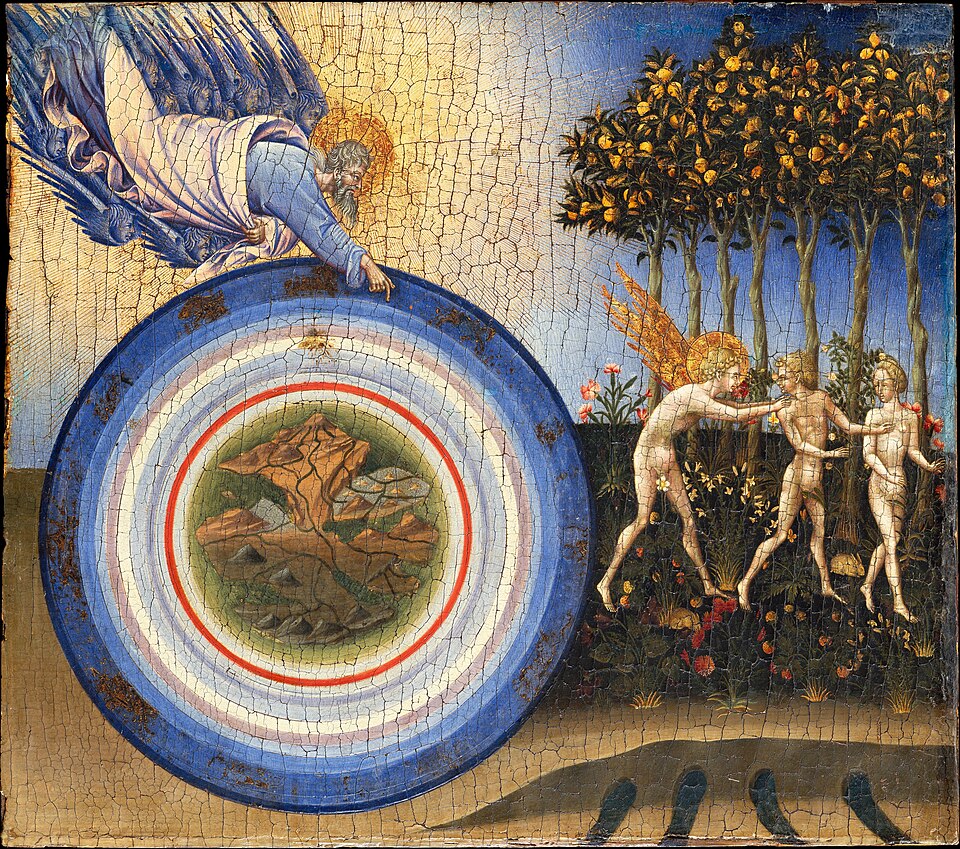
The Creation of the World and the Expulsion from Paradise, 1445
For centuries, humans have been imagined as embedded in hierarchical orders or fraternal relations of visible and invisible beings, divinely created and sharing a common life where values, spirit and matter could not be separated. It is sometimes forgotten that early scientific observations were conducted by people with a radically different view of the universe to the one that is dominant today.
Paradise and the wilderness
As Western science grew as a secular discipline, studies of matter and life became less about revelation, but ever more about detailed studies of material, species, ‘biodiversity’, human creativity and ingenuity, and the self. But as technology and cities expanded, so did the sense that Paradise had been mislaid, and the wilderness – long seen as a largely hostile place, with some exceptions – came to be viewed through a romantic lens, as a territory to be conquered and mastered, or as a passive victim.
In the West, the myth of a sublime and pristine wilderness and nostalgia for lost Paradise sit uneasily alongside a largely functional, mechanistic and colonial view of nature as a ‘resource’, and fear of ecological collapse. These views are dominant rather than universal, as witnessed by folk and indigenous cultures that maintain diverse experiences of an enchanted or spirit-filled cosmos.
‘All sentient beings’
Many other contrasting cosmologies continue to exist across cultures. One can be found in Tibetan Buddhism, where humans are not separated from ‘nature’ in the same way, but are intrinsically entangled. Tibetan Buddhism conceives itself as coexisting with “the earth, the waters, and the sky”. As Danny Yu argues, the landscape of Tibet constitutes both a religious mindscape and a natural environment, with the two dimensions mutually constitutive and inseparable.
A key concept in the Tibetan language, semchen tamché (all sentient beings), encapsulates a fundamental relational ontology between humans and non-human life.
This becomes particularly evident in the case of plateau pika management in Sogzong, Qinghai. Dominant policy narratives frequently attribute rangeland degradation to overgrazing and mismanagement, occasionally compounded by climate change, thereby positioning pastoralists and their livestock as primary agents of ecological decline. Correspondingly, rangeland restoration strategies on the Tibetan Plateau have largely relied on technocratic interventions, including poisoning plateau pikas, reseeding, and the imposition of grazing bans. Over time, however, such interventions have generated not only ecological consequences, such as cascading biodiversity loss, but also profound moral tensions within pastoral communities.
In contrast, some pastoralists have adopted approaches grounded in religious and moral practice. For example, villagers have placed prayer flags near pika burrows, using the sound and symbolic presence of the flags to deter pikas without killing them. This practice reflects a shift from a paradigm of control to one of care, and an ethic of coexistence, rooted in an epistemology that emphasizes interdependence among all sentient beings and the land.
The powerful imaginary that ‘nature’ exists in a pristine state, separate from humans and livestock, and that biodiversity can only be preserved by removing what is not ‘pristine’; whether humans, livestock or pika, both echoes the modern nostalgia for a lost Eden – the idea that nature was whole and harmonious until human activities disrupted it – but also a broader assumption that we will turn to now: the idea that, if left alone, ‘nature’ will ‘bounce back’ to some original, ideal baseline state.
Uprooting baselines
Sociologists, human geographers and political ecologists remind us that baseline ideals of what a healthy landscape and ecosystem should look like are highly contingent on and shaped by context, generation, and the relative positioning of different voices and ways of knowing. Baseline ideas of ‘nature’ do not emerge from science alone, but are influenced by religion, romanticism, social values and popular media, often dominated by the perspectives of affluent, urban societies.
Ecologists, particularly evolutionary ecologists, unwittingly perhaps, suggest that anthropocentric framings have profoundly shaped modern wilderness ideals. Even within the English language, the distinction between ‘wild’ and ‘domesticated’ animals reveals an implicit distinction: domesticated animals are seen as belonging to human-altered landscapes, and therefore as incompatible with ‘true’ nature. Meanwhile, WoDaaBe Fulani pastoralists describe cows as domesticated and ‘wild’. Yet from an evolutionary perspective, this boundary is far less clear-cut. Messy co-evolutionary processes explain how domesticated animals all have wild relatives and there is a continuum, between what we consider as ‘wild’ and domesticated.
Seen through this evolutionary lens, the baseline idea of pristine human-free nature begins to unravel, and dominant notions of what is ‘natural’ or ‘wild’ are shown to be constructs and world-views that shape how we interpret ecosystems and biodiversity.
In Open Ecosystems: Ecology and Evolution Beyond the Forest Edge, William Bond challenges the widespread assumption that humans and livestock (or large herbivores more generally) are inherently harmful to biodiversity by reframing this as a myth rooted in forest-centric baseline ideals.
A key misconception is the idea that grasslands, savannas, and shrublands are degraded versions of forests caused by human activity (cutting trees down, grazing or burning). Bond shows how, instead, ‘open ecosystems’ have developed through the co-evolution of grazers, fire and humans. This shows how ‘disturbance’ creates particular forms of biodiversity in grasslands, and it challenges the persistent assumption that human-influenced landscapes such as grazed grasslands are necessarily species-poor. On the contrary, many open ecosystems are biodiversity hotspots, often characterized by high levels of endemism, where certain keystone ground-nesting bird species depend on the habitat conditions created by people and livestock.
By relying on overly simplified or colonial imaginaries of ‘nature’ with specific baseline ideals, we risk intervening in ways that paradoxically harm the ecosystems we aim to protect.
Conclusion: challenging the myth
Biodiversity is not a fixed state to be restored, but a layered, evolving and dynamic process that cannot be reduced to linear relationships between people, livestock and wildlife. Biodiversity takes on new meanings as they are transformed by social movements. This means we need to pay attention to who is determining what a ‘pristine’ baseline of biodiversity looks like, and how the enduring myth that people and livestock are inherently detrimental to biodiversity is being used and mobilised, and for what and who’s purposes.
We suggest that challenging this myth requires challenging how we understand ‘Nature’ itself, and here perhaps, we should turn to non-dominant, yet long-standing, worldviews.
As a Tibetan aphorism states, “pastoralists depend on yaks, and yaks depend on grassland.” Humans and livestock thus constitute two integral components of the rangeland socio-ecological system. Evidence from rangeland restoration practices across the Tibetan Plateau and beyond suggests that sustainable restoration and governance cannot be achieved without the active participation of pastoralists and their herds. Bookchin, Yussuf and Moore, for example, suggest shifting the focus altogether away from anthropos and towards how anthropos is organized to understand biodiversity loss.
The Tibetan aphorism instead suggests an alternative way of ‘knowing’ biodiversity. In pastoralist contexts, biodiversity is not conceived solely as the conservation of ‘wild’ species through the exclusion of human and livestock presence. Rather, it is understood relationally – recognizing humans, livestock, grassland, wildlife, and the existence of non-humans, as co-constitutive elements of a single socio-ecological system. The removal of any one of these elements risks disrupting the integrity of semchen tamché, the ‘circle of life’ that sustains the interdependent relationships between human and non-human beings.
This piece was written with contributions from Palden Huadancairang and Nathan Oxley, and feedback from Francis Masse.
 Want to discuss myths about biodiversity? Join our fourth rangeland myths online conversation of 2026, on the myth of ‘people and livestock are bad for biodiversity’, on Thursday, 28 May from 11:00 am – 12:30 pm (UK time).
Our speakers are Pablo Manzano, Munib Khanyari and John Harold, and the discussion will be co-chaired by Rashmi Singh and Francis Masse.
We warmly invite anyone with an interest in rangelands, pastoralism and myths about them, to join, share your stories and rethink how we ‘see’ rangelands and pastoralism.
Further reading
Reconstituting nature conservation: Towards a careful political ecology | Request PDF
Multinatural geographies for the Anthropocene
Mindscaping the Landscape of Tibet
Birds of the Bush: Wodaabe Distinctions of Society and Nature
The Myth of a Wilderness Without Humans | The MIT Press Reader
Open Ecosystems: ecology and evolution beyond the forest edge | Oxford Academic
The Avery Review | On “That Word, Nature”
Read more
The REPAiR Project blog brings diverse views from our project team and collaborators into conversation around key themes and ideas.
Related content
10 May 2026 Pablo Manzano
The misunderstood relation between biodiversity and pastoralism
We should question deep rooted assumptions about how pastoralists, livestock and wildlife can co-exist.
8 April 2026 Amber Huff
Myth: Carbon is Carbon
There is a powerful myth at the heart of global carbon markets: the deceptively simple idea that ‘carbon is carbon’.
9 January 2026 Amber Huff
Myth: The tragedy of the commons is inevitable
As the International Year of Rangelands and Pastoralists calls attention to the global diversity, importance, and governance of the world’s rangelands, the myth of the tragedy of the commons is particularly relevant and illustrative of the power and dangers of universalising and reductive myths.
27 December 2025 Amber Huff & Linda Pappagallo
Rethinking what we think we know about rangelands and pastoralism
In this introductory blog on ‘rangeland myths’ we emphasise the need to rethink what we think we know about rangelands and pastoralism in ways that are open to diverse perspectives, experience and knowledges.